



Discover resources by Greg Crawford, former NIC staff member, focusing on justice-involved veterans, Veterans Treatment Courts, and diversion strategies.
Content Written by this Author
Develop a better understanding of the Veteran Sequential Intercept Model (V-SIM) and the intervention strategies and resources available at each intercept in part one of NIC’s four-part series highlighting reentry, diversion, and desistance alternatives for justice-involved veterans as they progress through the criminal justice system. Veterans transitioning from the military to civilian life may have unique underlying conditions, such as post-traumatic stress disorder, traumatic brain injury, and other veteran-specific mental health concerns. The SIM delineates interventions at distinct stages of the criminal justice system that have been recognized to assist in addressing the underlying needs of veterans with service-related mental health issues. If veterans with these conditions get involved with the criminal justice system, it can result in complex and challenging situations.
ID: 033669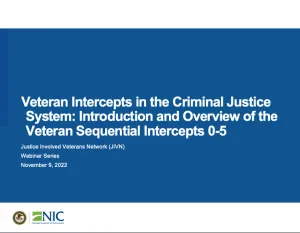
This paper is the fourth in the National Institute of Corrections justice-involved veteran compendium project. It illuminates programs in prisons across the country whose goal is to prevent recidivism by justice-involved veterans, and by so doing improve the safety of law enforcement officers, correctional officers, inmates, and the public. It illustrates the design/development, implementation, and sustainment of initiatives taken by corrections officials who have set up specialized housing-in pods, dorms, units, wings, or floors-and programming for military veterans.
ID: 033092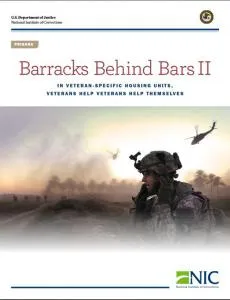
- This white paper is based on a series of interviews, buttressed by personal observations, of key players in several jurisdictions where law enforcement officers, Veteran Justice Outreach Specialists from the U.S. Department of Veterans Affairs (VA), and community-based agency representatives collaborate to implement approaches to de-escalate veterans in crisis in our communities.
ID: 033091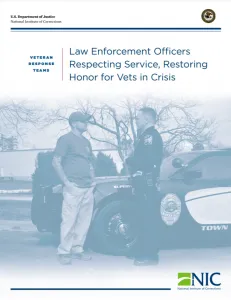
"This white paper is based on a series of interviews, buttressed by personal observations, of key players in half a dozen jurisdictions where Veterans Treatment Courts have been operating with marked success. Neither graphs nor charts nor a plethora of statistics are employed to illustrate the protocols and practices of these therapeutic courts. Instead, proponents and practitioners intimately involved in the founding and operation of these courts relate how they are “the right thing to do” for combat veterans who commit certain crimes that are associated with the lingering legacy of their wartime experiences.
ID: 030018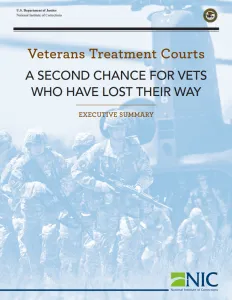
- This program on justice-involved veterans, highlights the lifesaving role being played by veterans treatment courts (VTCs) across the country.
ID: 029869![document cover for Veterans Treatment Courts: A Second Chance for Vets Who Have Lost Their Way [Internet Broadcast]](https://s3.amazonaws.com/static.nicic.gov/nicic.gov/files/styles/medium/s3/media/image/029869-veterans-treatment-courts-a-second-chance-for-vets-who-have-lost-their-way-internet-broadcast.png.webp?VersionId=bjO8t35El.S5U7gMJJIObFxVf2BCDIKh&itok=xG2O2DVh)