Discover research-backed resources by Spurgeon Kennedy, including national standards for CJCCs and innovative strategies for success-based pretrial supervision.
Content Written by this Author
- The National Standards for Criminal Justice Coordinating Councils is a comprehensive framework for the formation and ongoing management of criminal justice coordinating councils (CJCCs).
ID: 033675
Pretrial supervision is a critical function of most pretrial services agencies. Unfortunately, most pretrial supervision strategies and conditions are not supported by research. Pretrial services agencies often recommend—and courts order—conditions that are inconsistent with the goals of promoting court appearance and arrest-free behavior. This can expose individuals who would otherwise comply with these goals to bail revocations due to technical violations.
This publication describes the elements of a "success-based" pretrial supervision protocol that emphasizes successful outcomes as a goal, encourages individualized conditions of supervision, and includes interventions to deal with court nonappearance. It also gives practical examples of how pretrial agencies can implement these elements.
ID: 033628
- Behavioral health and social service needs are common in most arrest populations. For most individuals, these needs will not interfere with making court appearances and remaining arrest-free before trial.
ID: 033627
The past two decades have enhanced our understanding of pretrial risk. We now know that most individuals with pending criminal cases make scheduled court appearances and remain arrest-free as they await trial. When missed court dates occur, they often are not intentional abscondence but rather the result of unintentional or unavoidable circumstances. Further, most new cases filed against pretrial defendants involve misdemeanors and lower-level felony charges, not violent crimes.
However, while we recognize the infrequent and dynamic nature of pretrial misconduct, most justice systems define, and measure missed court appearances using the dated and overly broad “failure to appear” descriptor and view new case filings mostly as serious offenses affecting public safety. The result is an overestimation of defendant risk and overly punitive responses to misconduct.
ID: 033626
This publication presents findings from a national survey of criminal justice coordinating council (CJCC) directors and members. It is one of a series of publications aimed at enhancing the literature about CJCCs and highlighting their purpose and value in shaping local justice systems.
The survey findings are intended to broaden our knowledge about CJCCs and to:
- assist jurisdictions interested in forming a coordinating council
or - help existing CJCCs strengthen their council.
ID: 033618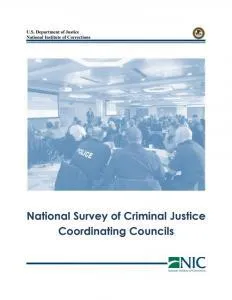
- assist jurisdictions interested in forming a coordinating council
Criminal justice coordinating councils (CJCCs) emerged in the 1970s and 80s as a means for systemic collaboration to improve the justice system. To date, however, there has been little research on these entities. To address this knowledge gap, Justice Management Institute surveyed CJCC members nationwide to understand what value these professionals experience through their CJCC membership and the benefits that CJCCs bring to their jurisdictions. This publication, developed with funding from the National Institute of Corrections, presents findings from that survey.
ID: 033617