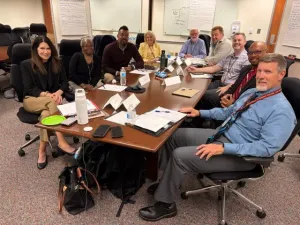
In Washington, DC, on April 28-29, 2026, NIC convened community corrections stakeholders from across the nation to engage in strategic dialogue focused on emerging trends, critical concerns, evolving needs, and future opportunities within the field of community corrections. Participants for this one-time event represented a cross-section of leadership and expertise, including a Federal Chief Probation Officer from North Dakota, a Branch Chief from the Administrative Office of the United States Courts in Washington, D.C., a Chief Probation Officer from Pinal County, Arizona, representatives from the Interstate Compact Offender Tracking System (ICOTS), and an Executive Administrator from Houston, Texas.
The group had no formal name; an indication that this effort was truly in its beginning stages. Over the course of a day and a half, participants engaged in thoughtful discussion, candid debate, and collaborative problem-solving. While perspectives occasionally differed, the group consistently worked toward consensus in pursuit of meaningful outcomes for the profession.
One of the most significant accomplishments of the meeting was the group’s ability to identify critical needs within the field of community corrections. The discussions generated numerous insightful and achievable goals to strengthen collaboration, improve practice, and support professionals working across jurisdictions and systems. By the conclusion of the meeting, participants left with a strong sense of shared purpose, accomplishment and a vision to inform stakeholders of the work being accomplished within the field of community corrections.
At its core, the NIC meeting was about more than strategy development—it was about strengthening relationships with community corrections partners nationwide and breaking down siloed approaches to addressing complex challenges. New alliances were established, partnerships were reinforced, and ideas were shaped through collaboration and consensus. These efforts reflect the mission of the National Institute of Corrections: to advance public safety by shaping and enhancing correctional policies and practices through leadership, collaboration, and innovation.