



Definition: Title 38 of the Code of Federal Regulations defines a veteran as, a person who served in the active military, naval, or air service and who was discharged or released under conditions other than dishonorable.
Content Associated with this Tag
Studies show that deployment-related trauma exposure, combined with increased incidence of mental health and substance use disorders, elevate veterans’ risk of contact with the justice system.
ID: 033715
Supporting Transition to Civilian Life Across the Sequential Intercept Model
They were veterans before they were incarcerated individuals. That is the sentiment and approach to veterans reentry of Sharon Kirkpatrick, member of the Washington Women Veterans Advisory Committee. Upon meeting with a veteran for the first time, she begins by acknowledging their military service, both because she honors their sacrifice and because the veterans need to hear and embrace these words for themselves. Helping veterans understand that they are more than their criminal charge is the first step to helping them see beyond their current circumstances and guiding them along the path of reentry.
ID: 033668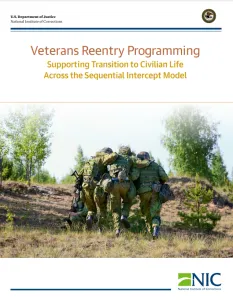
This white paper is a collaboration between the National Institute of Corrections, the Substance Abuse and Mental Health Services Administration, the U.S. Department of Veterans Affairs, and the National Institute of Corrections-sponsored Justice-Involved Veterans Network.
ID: 033665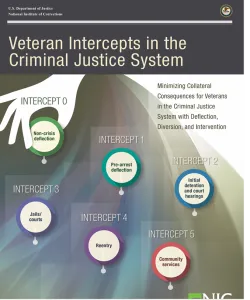
This paper is the fourth in the National Institute of Corrections justice-involved veteran compendium project. It illuminates programs in prisons across the country whose goal is to prevent recidivism by justice-involved veterans, and by so doing improve the safety of law enforcement officers, correctional officers, inmates, and the public. It illustrates the design/development, implementation, and sustainment of initiatives taken by corrections officials who have set up specialized housing-in pods, dorms, units, wings, or floors-and programming for military veterans.
ID: 033092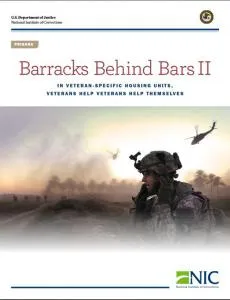
- This white paper is based on a series of interviews, buttressed by personal observations, of key players in several jurisdictions where law enforcement officers, Veteran Justice Outreach Specialists from the U.S. Department of Veterans Affairs (VA), and community-based agency representatives collaborate to implement approaches to de-escalate veterans in crisis in our communities.
ID: 033091
The purpose of Veterans Treatment Courts is to offer vets with a substance use problem and/or diagnosis of a mental health issue an opportunity to avail themselves of treatment-oriented justice. Based on anecdotal evidence and an increasing accretion of data from the field-in many of the projects funded by the National Institute of Corrections and the Bureau of Justice Assistance-these courts appear to be achieving their goal. They are helping worthy individuals find a degree of redemption while paying their debt to society. They are restoring family relationships, strengthening communities, cutting rates of recidivism and, hence, making communities safer.
But what of those veterans who are incarcerated, serving a sentence, or awaiting trial or other resolution of the charges against them?
ID: 033065
"This white paper is based on a series of interviews, buttressed by personal observations, of key players in half a dozen jurisdictions where Veterans Treatment Courts have been operating with marked success. Neither graphs nor charts nor a plethora of statistics are employed to illustrate the protocols and practices of these therapeutic courts. Instead, proponents and practitioners intimately involved in the founding and operation of these courts relate how they are “the right thing to do” for combat veterans who commit certain crimes that are associated with the lingering legacy of their wartime experiences.
ID: 030018
- This program on justice-involved veterans, highlights the lifesaving role being played by veterans treatment courts (VTCs) across the country.
ID: 029869![document cover for Veterans Treatment Courts: A Second Chance for Vets Who Have Lost Their Way [Internet Broadcast]](https://s3.amazonaws.com/static.nicic.gov/nicic.gov/files/styles/medium/s3/media/image/029869-veterans-treatment-courts-a-second-chance-for-vets-who-have-lost-their-way-internet-broadcast.png.webp?VersionId=bjO8t35El.S5U7gMJJIObFxVf2BCDIKh&itok=xG2O2DVh)