



Module 6: Screening and Assessment
This visual indicates where Screening and Assessment fits in the Transition from Jail to Community model.
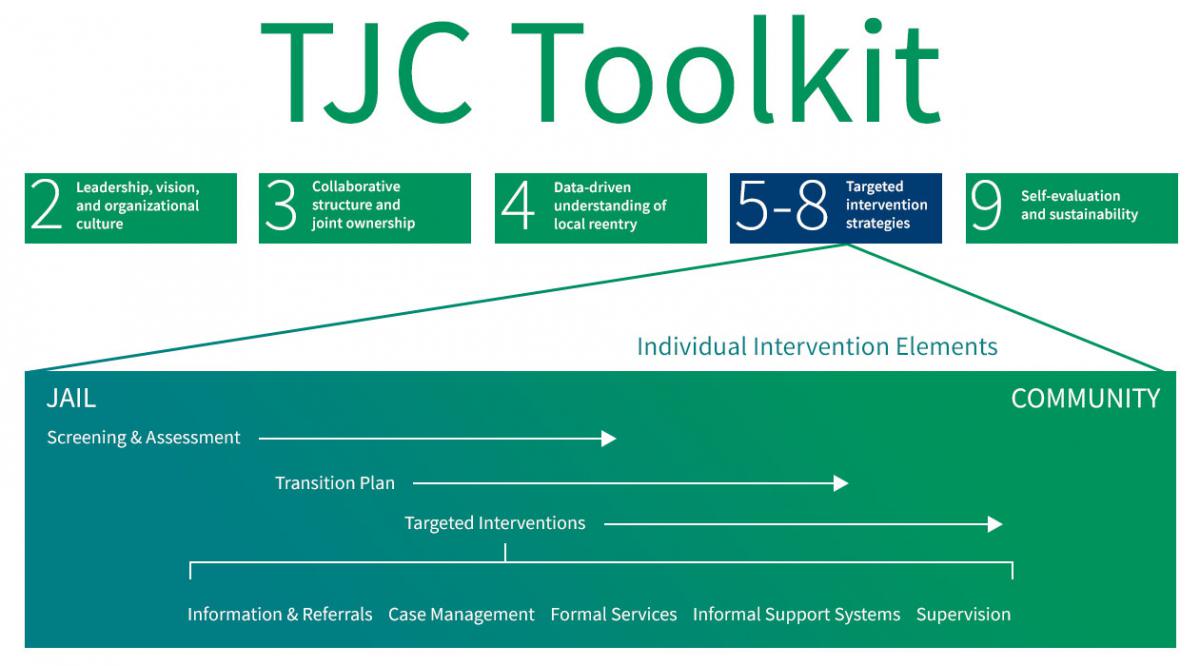
Welcome to Screening and Assessment. This module focuses on screening and assessment, the starting point of any targeted intervention strategy.
The implementation of facility-wide screening and assessment allows us to triage higher-risk inmates into the programs and interventions targeted for their needs, without spending unnecessary resources on low-risk offenders who are not likely to return to jail. The process allows us to target scarce resources for the offenders who have the greatest needs.
—Shannon Murphy
Reentry Director and TJC Site Coordinator
Douglas County Sheriff's Office
Douglas County, Kansas
Before we begin, take some time to think about the screening and assessment your facility presently does.
A basic definition for screening is the use of a brief instrument to identify high risk/needs individuals who will benefit most by enrolling in intensive jai transition programming initiatives; while assessment is the process of identifying and documenting risk and needs specific to each individual to inform treatment decisions and develop evidence-based case plans.
Ask yourself the following questions:
| 1. | Does your intake screening process utilize an empirically based medical screen(s)? | |
|---|---|---|
| 2. | Does your intake screening process identify individuals with mental health issues? | |
| 3. | Does your intake screening process identify individuals with substance abuse issues? | |
| 4. | Does your intake screening process identify individuals with suicide risk? | |
| 5. | Do individuals who score positive on mental health or substance abuse screens receive further empirically based assessments? | |
| 6. | Does your intake screening process utilize an empirically based pretrial release screen?
| |
| 7. | Are detainees with low pretrial release risk scores generally recommended for release? | |
| 8. | Does your intake screening process utilize an empirically based risk-to-reoffend screen(s)? | |
| 9. | Do individuals who score medium or higher on the risk and needs screens receive further empirically based assessments? | |
| 10. | Are your risk and needs screens distinct from your classification system instrument? | |
| 11. | Does your facility use an objective classification system for all incarcerated people? |
Did you answer “All the time” to the above questions? If not, this module is meant to help you understand why these different assessment processes are so important to the Transition from Jail to Community(TJC) model.
This module has five sections and will take between 10 and 15 minutes to complete.
Recommended audience for this module:
- Sheriffs
- Jail administrators
- Correction officers involved in transition efforts
- Jail treatment staff
- Community corrections staff
- Reentry coordinators
- Community providers
- Probation officers
- Pretrial services staff
- County board members
- Criminal justice council members
- Judges and Officers of the court
This module also includes a list of links to commonly used screens and assessments.
Module Objectives
In Module 5: Targeted Intervention Strategies, you learned about the 11 tasks outlined in the Targeted Intervention Strategies section of the TJC Implementation Roadmap and the importance of using the risk-need-responsivity model to determine the appropriate strategies to address an individual's criminogenic factors pre- and post-release.
In this module you will have the opportunity to explore the second and third Targeted Intervention Strategies tasks of the TJC Implementation Roadmap , which highlights the importance of screening and assessing pretrial and sentenced individuals during incarceration and upon their return to the community.
Task 2. Apply screening instruments to all jail entrants to identify incarcerated individuals of varying levels of risk.
Task 3. Apply a comprehensive risk/needs assessment instrument(s) to selected higher risk jail entrants.
This module has five sections:
- The Need for Screening
- The Need for Assessment
- Selecting Screens and Assessment Tools
- The Logistics of Screening and Assessment
- Terms Used in the Field
By the end of this module, you will be able to
- Explain the purpose and importance of using screens and assessment tools.
- Select screening and assessment instruments that will identify the level of risk and needs within your jail population.
- Create a structure to apply screening and assessment tools in your facility or agency.
- List the basic requirements of training staff to administer the instruments.
Figure 1: Targeted Intervention Filter

Figure 1 summarizes the relationships among screening, assessment, transition planning, and jail and community interventions and their usual ordering in time. Note that individuals identified as high and medium risk during screening are tracked for assessment, unlike those screened as low risk. Whether interventions will begin in the jail or in the community will depend on length of stay (LOS)
Module 6: Section 1: The Need for Screening
This section provides an overview on why and how routine screening of individuals' risks, needs, and strengths is an essential component of an effective jail transition intervention strategy. Remember that screens are not used to diagnose an individual's risk or needs, but only to identify the individual for further assessment or other implementation efforts designed to address specific needs in lower risk populations such as opiate addiction or mental illness.
We start with the five Ws (who, what where, when, and why) and one H (how) to help us with our understanding.
Why do you screen?
Effective screening practices help jail administrators and professionals throughout the local system of criminal justice first understand who is in the jail and why. The following are four specific reasons to screen your population.
First, there are almost always limited resources for jail-based interventions relative to the number of people booked into jails. Screening is the first step in a triage process to guide jail staff and TJC partners in prioritizing people for reentry engagement. As a jurisdiction makes progress in building a diverse portfolio of jail reentry interventions, a triage process starting with screening that helps match the right individuals to the right interventions only becomes more important to success
Second, screening helps find the people who are most likely to return to jail repeatedly absent significant supportive interventions. For example, application of screening criteria is the basis for essentially all intervention efforts focused on frequent users or familiar faces—individuals experiencing multiple jail bookings annually.
Third, screening results can also help identify people who should be prioritized for post-release engagement in the community, even if (or especially if) they are not in the jail long enough to engage deeply in jail-based interventions.
Finally, the role of screening (and assessment) in the TJC process is to guide supportive interventions that contribute to reentry success. If their use is extended to purposes such as determining who should be subject to greater control of surveillance, this undermines their intent and the support of partners necessary for a systems approach to jail transition.
Who do you screen?
Universal screening is a key element of the TJC model. This means that everyone entering your facility, regardless of length of stay or conviction status, is screened for risk to return to the jail, pretrial release, health, and behavioral concerns that might affect transition to the community. These screens help to identify:
- Detainees who can be safely released to the community pending court, either on their own recognizance or under pretrial supervision, if it is available.
- People jailed who need to receive more comprehensive services and a full assessment with a risk and needs assessment tool.
What do you screen them for?
Physical health, behavioral health, risk of drug or alcohol withdrawal, and suicide risk screens are probably administered to every new arrestee arriving at your facility. In addition, the TJC model recommends a quick risk-to-reoffend and pretrial release screens. These screens allow you to group the arrestees into low, medium, and high risk and needs categories.
- The risk-to-reoffend screen allows you to group the arrestees into low, medium, and high risk and needs categories.
- The pretrial release screen will help identify the risk of failure to appear in court and danger to the community during the adjudication period.
A TJC Triage Matrix goal is to identify low-risk offenders and assign them to minimal intervention to prevent the inefficient expenditure of time and resources on extensive assessment and programming, and to separate low-risk individuals from their higher risk counterparts.
Include the following items in screening to evaluate risk within the jail and in the community:
- Physical health
- Infectious diseases
- Substance abuse
- Mental health
- Suicide risk
- Need for medication
- Disabilities
- Criminal history
- Current offense
- Risk to reoffend
- Pretrial release
In Section 3, we discuss a number of valid, short, and easily administered screens available to identify an incarcerated person for further assessment.
Where do you screen them?
Screening should be done at intake during central booking or soon after.
When do you screen them?
Screening takes place early on. Here are some key times when administering screens is most common:
On arrival at the jail
- A brief health screen to “determine if arrestee can be admitted to the jail based on any medical needs (e.g., risk of drug or alcohol withdrawal; acute medical needs) that must be addressed at a medical facility.” 1
During the booking process
- A brief screen(s) to identify physical, behavioral health, risk of drug or alcohol withdrawal, and suicide risk.
- A brief screen to classify arrestees into low, medium, and high risk-to-reoffend categories.
Before the first court appearance
- A brief pretrial release screen to classify arrestees into low, medium, and high risk of flight and re-arrest.
How do you screen them?
A system of valid and reliable screens requires the following steps:
- Develop or select validated screening instruments.
- Create a structure to apply the screening tools to all jail entrants.
- Train staff to apply the screening tools.
- Apply the screening tools to all jail entrants.
- Analyze the information to flag those who need further assessment.
Now that you understand the five Ws and one H of screening, you will want to take the time to conduct a case flow analysis of your present screening process to understand fully the reasons you perform screening and what you will do with the information obtained. A Screening and Assessment Case Flow Process template is available in Section 1 of Module 8: Tailored Transition Interventions.
1 Martin, M. D., & Rosazza, T. A. (2004). Resource guide for jail administrators . National Institute of Justice, p. 141.
Summary
In this section you learned that it is important to conduct universal health, risk to reoffend, and pretrial release screens of all arrestees entering your facility. A comprehensive risk/needs assessment can then be administered to individuals who score in the medium or high range on screening instruments.
Actuarial risk assessment tools that predict recidivism have come under increasing criticism for their potential to contribute to inequity. Nevertheless, these tools are needed to help identify who is most likely to return to jail absent intervention and assess the most critical needs to be met, as long as the tool is validated properly and not used to determine sentencing.
Unfortunately, we remember the time, not too long ago, when subjective, clinical judgment decisions were often biased and tended to deny or lessen treatment options for people of color and women. This is not to say that the widely accepted best practice of relying on validated risk/needs assessments to inform objective decision making is perfect; nor do these tools ensure that the right people get the right treatment all the time. However, standardized actuarial assessment tools do allow for transparency and support consistency in decision-making. This is an important corrective to the “gut feeling index” often used by jail staff to determine housing placement and programming.
Therefore, instead of “throwing the baby out with the bath water” and getting rid of risk/needs assessments, supervisory personnel need to be aware of the potential for bias when using assessment tools and employ appropriate measures to monitor consistency, objectivity, and mitigate bias. These practices ensure the proper implementation of risk/needs assessments include:
- Using a validated risk needs assessment tool that has been proven to be fair and accurate. The tool validation should include analyses of how the tool performs by race, ethnicity, and sex, to gauge fairness and accuracy on those dimensions.
- Training staff on how to administer the risk/needs assessment tool in a fair and unbiased manner.
- Developing clear policy to direct when, where, and for what purpose risk/needs assessments are used that includes consideration of timing and information sharing during the process of adjudication. Application of screening and assessment for reentry purposes should not place individuals at greater risk of sanction.
- Conducting regular audits of the use of the risk/needs assessment tool to identify and address any potential biases across age, race, and sex by staff and facilities conducting assessments.
- Evaluating inter-rater reliability by conducting duplicate assessments by different assessors as part of periodic audits
- Coupling assessment with reentry approaches focused on supporting success for people at all levels of risk and need.
- Seeking input from formerly justice-involved peer mentors to help inform staff on delivering screening assessments to inform programming and interventions and how staff can educate participants about their programming and connections to services upon release.
By following these guidelines and best practices, your jail can help to ensure that risk/needs assessments are used in a fair and unbiased manner to achieve best possible outcomes for all concerned regardless of race, ethnicity, sex, or socioeconomic status. Without question, years of research have found that actuarial assessments are the best tools available to effectively match the right interventions with the right person resulting in the best possible outcomes.
Module 6: Section 2: The Need for Assessment
This section provides an overview on why and how assessment of individual's risks, needs, and strengths is an essential component of an effective jail transition intervention strategy. Just as we did in the previous section, we start with the five Ws (who, what, where, when, and why) and one H (how) to help us with our understanding.
Who do you assess?
Assessment is used for those who are in the target population for intensive reentry interventions, as identified by screening for risk to re-offend.
What do you assess them for?
Individuals who score in the medium or higher range on screening should then be administered a comprehensive risk/needs assessment instrument to classify them by risk/need and offer them appropriate treatment and transitional services. The assessment process is likely to uncover many needs (criminogenic and non-criminogenic) among your incarcerated population that affect their current level of functioning and their ability to transition back to the community. The assessment process then guides individualized case planning designed to target and mitigate each individual’s specific needs.
Where do you assess them?
Depending upon the assessment instrument utilized, officers or case managers will require some additional training to create the proper atmosphere for assessment. The assessment process should take place within a private area where an officer or a case manager can engage the incarcerated person in effective two-way communication. The dialogue should be structured to facilitate discussion around the individual's dynamic criminogenic needs or changeable factors within the individual's life that, if addressed, will increase the probability of a successful transition from jail to home.
When do you assess them?
Assessment is ongoing — beginning at intake and continuing in the community after the person is released. Here are some key times when various screening and assessments are most common:
Immediately after booking
- Any person who screens positive for suicide risk, drug or alcohol withdrawal, or any serious medical need should be further assessed immediately by a qualified medical professional and monitored closely.
After admission to the jail
- As resources allow, people who were identified by screening with medium or higher risk to reoffend should be administered a comprehensive risk/needs assessment instrument after being admitted to the jail.
- Guided by information obtained as a result of comprehensive risk/need assessments, there may also be specialized assessments that will be useful to examine specific higher need areas such as substance/alcohol abuse, mental illness, or other criminogenic and non-criminogenic needs.
Every six, months while incarcerated
- Depending on available resources, individuals should be reassessed every six months while incarcerated to inform the construction of their initial jail-to-community transition plan and subsequent revisions to that plan.
Situational
- Reassessment should also occur based on individual circumstances. Martin and Rosazza 2 recommend six reasons to reassess:
- Improvement or deterioration of an incarcerated person's behavior
- A crisis in the incarcerated person's life
- Medical or mental health emergency
- Court documents and commitment orders
- An individual's request for reclassification
- An officer's request for classification of an incarcerated individual
In the community
- Upon release, the primary agency charged with working with the individual should review the individual's file and determine what further assessments, if any, are needed.
Why do you assess?
Assessment informs decisions about classification, placement, and programming in the jail and transitional care upon release. Assessment is used to identify the criminogenic needs of an individual - those factors that are related to the likelihood of future criminal behavior and can be changed. It also indicates whether a specialized needs assessment is warranted.
Here are four key reasons for assessment:
- Allows you to see the big picture of your population's needs and trends over time.
- Allows you to make informed decisions regarding efficient and cost-effective strategies to address criminogenic needs during incarceration and upon release.
- Helps identify prevalent criminogenic needs.
- Identifies the level of support, responsibility and training your staff and contract vendors need to work with incarcerated people before and after release.
How do you assess them?
A system of valid and reliable assessment requires the following steps:
- Develop or select assessment instruments that are or will be validated for use with your population.
- Create and implement protocols to apply the assessment tools to selected jail entrants.
- Train staff to apply assessment tools.
- Identify the subset of incarcerated people to receive formal assessment (medium and high risk).
- Identify the assessment tool (or tools) to be applied to medium- and high-risk incarcerated people.
- Create and implement protocols to apply assessment tool(s) to jail entrants identified in need of more extensive assessment(s).
Click here for TJC Pre-Implementation Case Flow Process Screening and Assessment Template.
For more information
1. Christensen, G., Jannetta, J., & Willison, J. B. (2012). The role of screening and assessment in jail reentry: A transition from jail to community initiative practice brief. Urban Institute.
2. Johnson, K. D., & Hardyman, P. L. (2004). How do you know if the risk assessment instrument works? Topics in Community Corrections, pp.20-26.
2 Martin, M. D., & Rosazza, T. A. (2004). Resource guide for jail administrators . National Institute of Justice, p. 141.
Summary
In this section you learned that it is important to conduct a risk and needs screening of all arrestees entering your facility. A comprehensive risk/needs assessment is then administered to individuals who score in the medium or high range on screening instruments.
Module 6: Section 3: Selecting Screens and Assessment Tools
This section provides assistance and guidance in selecting appropriate screening tools and assessment instruments that satisfy both the informational requirements of the TJC model and local concerns (e.g., inexpensive, easy to administer, yield information useful to a variety of partners). This section offers different types of instruments to assess specific risk and needs of incarcerated individuals.
Questions to think about before choosing screens and assessments include the following:
- Is the screen or assessment valid and reliable?
- Is the screen or assessment copyrighted?
- Is there any cost to use the screen or assessment?
- How much staff time is needed to complete the screen or assessment?
- What is the cost of administering the screen or assessment, including staff time and training?
- How much training is involved to administer the screen or assessment?
- Is medical, mental health, or substance abuse training necessary to administer the screen or assessment?
- Is the screen or assessment available in other languages?
- Is the screen or assessment available in electronic format?
Each jurisdiction must determine what criminogenic risk and need scores or “cut-points” will be utilized to assign medium- and high-risk individuals to available program tracks, sanctions, treatment, or some combination of system actions. Cut-points, or the threshold of risk/need identified by screening and/or assessment that is required to assign offenders to intensive interventions, must be jurisdiction specific, for they must consider a number of local factors such as the actual number of people in a given risk/needs category; existing service capacity (institutional and community based); and available resources, including staff, space, and bed capacity. In this world of shrinking resources, it is essential that jurisdictions establish cut-points to ensure that precious resources are spent on offender groups that are most likely to benefit.
Screens and Short Assessments Used During the Booking Process
The TJC model recommends that each person booked at your jail receive a short risk-to-reoffend screen and a pretrial risk assessment. The risk-to-reoffend screen will help identify those who need a full risk and needs assessment and are targeted to receive intensive services pre- and post-release as well as those of lower risk who are candidates for release, diversion, or alternatives to incarceration. The pretrial risk assessment will help identify the risk levels for failing to appear in court and rearrest. In some jurisdictions, the court may delegate to booking officers the authority to release those defendants who score as low risk on the risk assessment. The risk-to-reoffend screen will help identify those who need a full risk and needs assessment.
Though it may seem okay to cut corners and use the score from a risk-to-reoffend screen or assessment to determine who should receive pretrial release, a number of factors relevant in predicting criminogenic risk and needs do not predict pretrial risk. The use of separate instruments is advised.
In this section below, we highlight different types of screens and assessments commonly used in correctional settings that are well regarded by experts in the field. Our intent is not to endorse any individual tool, but instead to draw your attention to what is available, the average time to complete the instrument, and any cost associated with their use. Sometimes an instrument is free, but may require training by the developer. We also recommend that you click on BJA’s Public Safety Risk Assessment Clearinghouse Tool Selector for a more comprehensive list of risk assessment tools.
Risk-to-Reoffend Screens
The Proxy Risk Triage Screener is the shortest of the two, with only three items. The eight-item Level of Service Inventory—Revised Screening Version categorizes a person into a low-, medium-, or high-risk group.
Quick Risk Screening | |||||
|---|---|---|---|---|---|
| Tool Name | Cost | Time to Complete Interview | Inventory Items | Instrument Result | Additional Information |
| Proxy Risk Triage Screener (Proxy) | No cost | Five minutes or less | Three items – Current age, age at first arrest, # of priors | Risk of recidivism on an 8-point scale | https://www.j-sat.com/ |
| Level of Service Inventory—Revised Screening Version (LSI-R:SV) | Fee | 15 minutes | Eight items – Criminal history, education/employment, family/marital, companions, alcohol/drug problems, attitudes/orientation, personal/emotional | Risk of recidivism score on an 8-point scale and brief summary of dynamic risk areas that may need attention | https://mhs.com/ |
| attitudes/orientation, personal/emotional | areas that may need attention | ||||
It is also possible to develop a risk screener using the administrative data on the jail population available in a jurisdiction. This can be done by examining factors related to recidivism that are captured in the jail MIS and analyzing which correlate most significantly with recidivism. For an example of this process for developing a screening tool, see the Vera Institute’s work on creating the Service Priority Indicator for the New York City Department of Corrections. Developing a jurisdiction-specific screening tool is a much more analytically complicated undertaking than implementing one of the commonly used tools but may provide better prediction of recidivism.
Pretrial Risk Assessments
The following table highlights three pretrial risk assessment instruments. Once again, our intent is not to endorse any individual instrument, but instead to draw to your attention pretrial screens commonly used that are well regarded by experts in the field.
The Ohio Pretrial Assessment Tool is the shortest of the three, with seven items, the point totals are grouped into three levels of risk – low, moderate, and high. The eight-item Virginia Pretrial Risk Assessment Instrument categorizes a person into five levels of risk – lowest to highest. The Public Assessment Screen is the longest of the three (9-items) and measures risk on a scale from 1 to 6.
Quick Pretrial Assessments | |||||
|---|---|---|---|---|---|
| Tool Name | Cost | Time to Complete Interview | Inventory Items | Instrument Result | Additional Information |
| Public Assessment Screen (PSA) | No cost | 15 minutes or less | 9 items - current offense, pending charges, criminal history, age at time of arrest, failure to appear history, incarceration history | Risk score on a 6-point scale | https://advancingpretrial.org/psa/about/ |
Ohio Risk Assessment System Pretrial Assessment Tool (ORAS-PAT)
| No cost | 15 minutes or less | Seven items – Age of first arrest, criminal history, employment, residential stability, history of drug use, severity of drug use. | Risk score on a 9-point scale. | https://cech.uc.edu/centers/ucci/services/risk-assessment.html |
| Virginia Pretrial Risk Assessment Instrument (VPRAI) | No cost | 15 minutes or less | Eight items – charge type, pending charges, criminal history, failure to appear history, violent conviction history, length at current address, employed/primary care giver, history of drug abuse | Risk score on a 9-point scale | VPRAI |
Assessments for Persons Who Score Medium to High on a Risk/Needs Screen
Comprehensive criminogenic risk/need assessment instruments are targeted to those who scored medium to high on the quick screen, indicating that they may need more intensive intervention. Multipurpose risk/needs assessments are advantageous because they not only evaluate the risk of recidivism, but identify categories of needs in areas identified as being most likely to impact recidivism, including education, employment, financial, family, housing, leisure, substance abuse, criminal thinking, and other personal needs. By discerning these criminogenic needs areas, the assessment tools identify targets for intervention.
Research consistently identifies eight major criminogenic needs, and further distinguishes between the "big four" (those most strongly related to re-offending) and the lesser four. They are: 3
Big four criminogenic needs
- History of antisocial behavior
- Antisocial personality pattern
- Antisocial cognition
- Antisocial associates
Lesser four criminogenic needs
- Family/marital factors
- Lack of achievement in education/employment
- Lack of pro-social leisure or recreation activities
- Substance abuse
3 Andrews, D. A., Bonta, J., & Wormith, J. S. (2006). The recent past and near future of risk and/or need assessment. Crime & Delinquency , 52(1), 7-27.
1The following table provides information on seven comprehensive risk/needs assessments for treatment, planning, and placement of incarcerated individuals.
Criminogenic Risk/Needs Assessment | Resources | ||||
|---|---|---|---|---|---|
| Tool Name | Cost | Time to Complete Interview | Inventory Items | Instrument Result | Additional Information |
| Level of Service/Risk, Need, Responsivity – (LS/RNR) | Fee | 45-60 minutes | 43-item inventory – interview | Total risk/need score and 8 subdomain scores | https://www.mhs.com/ |
| Level of Service / Case Management Inventory (LS-CMI) | Fee | 45-60 minutes | 124-item inventory – interview Risk, needs, responsivity. Case and release planning | Risk/needs score, responsivity score, generates plan for case management | https://www.mhs.com/ |
| Correctional Offender Management Profiles for Alternative Sanctions (COMPAS) | Fee | 90 minutes | 98-item inventory – interview Risk, needs, responsivity Case and release planning | Risk/needs score and plan for case management
| |
| Ohio Risk Assessment System (ORAS) | No cost | 45-90 minutes | 101-item inventory – pretrial assessment, community supervision screening, community supervision full assessment, prison intake, prison reentry | Total risk/need score and 7 subdomain scores | https://drc.ohio.gov/oras |
| Correctional Assessment Intervention System (CAIS) | By jurisdiction Software license or hosted online | 60 – 75 minutes | 82 items | Risk/needs score, generates plan for case management | https://evidentchange.org/assessment/correctional-assessment-and-intervention-system-cais/ |
Here we briefly discuss some other screens and assessments used in the jails and the community throughout the country.
The Jacksonville (Florida) Sheriff's Office uses the three question Proxy risk screener to quickly and objectively sort all inmates booked into its Pretrial Detention Facility by risk to reoffend. The Proxy scores individuals as low, medium or high risk to reoffend based on a scale ranging from 2 to 8. Jacksonville selected the Proxy risk screener because it takes less than 5 minutes to administer and scores can be generated automatically; local recidivism analyses have also found the Proxy to be highly predictive. Jacksonville targets sentenced inmates screened as a medium to high risk on the Proxy for in-depth criminogenic risk/needs assessment.
Assessments that are Responsive to Women
Most risk and needs assessments are designed to be neutral in terms of applicability to men and women, but as a result can sometimes miss critical factors specific to women’s criminogenic risk and needs. For example, research indicates that relationship conflict, housing safety, and mental health are critical risk factors for women, but are often not included in neutral risk and needs assessments. Further, neutral risk and needs assessment tools can sometimes overestimate risk for women , leading to them being put in a higher security housing unit or higher-level community supervision than necessary and impact their outcomes.
Utilizing risk and needs assessment instruments that are responsive to women will provide you with more accurate information and allow you to better support women in your custody. The below table provides descriptions of evidence-based, women-responsive risk and needs assessment tools that you may consider implementing in your jurisdiction.
| Tools that are Responsive to Women | Description |
| Women’s Risk and Needs Assessments (WRNA) | This tool is a validated, peer-reviewed risk/need instrument specifically designed for incarcerated women. The WRNA measures women’s specific criminogenic needs, prior trauma and victimization, and strengths and protective factors. For more information, visit: https://socialwork.utah.edu/research/ucjc/wrna/ |
| Service Planning Instrument for Women (SPIn-W) | This tool is designed for women 17 years of age and older to help predict community supervision and reentry success. The tool includes a risk and needs assessment of gender-responsive items (for example, family stability factors, history of abuse and trauma, mental and medical health) and creates an individualized case plan. For more information, visit: https://www.orbispartners.com/risk-needs-assessment-women . |
| Northpointe Correctional Offender Management Profiling for Alternative Sanctions (COMPAS) for Women | The original COMPAS assessment tool has been expanded to include a responsive scale that can be used for incarcerated women. For more information, visit: https://equivant-supervision.com/solutions/case-management/ . |
Given women’s unique experiences with trauma, you could also consider using any of the following trauma-focused screening assessments. These tools, described below in a table from CSG Justice Center , are not specific to incarcerated women, but can be utilized with that population.
| Trauma Screening Assessments Name | Description |
| Adverse Childhood Experiences (ACEs) | This tool is self-administered and measure the effects of childhood experiences on adult health. To see the assessment, visit: https://www.traumainformedcare.chcs.org/resource/original-ace-questionnaire/ . |
| Life Events Checklist for DSM-5 (LEC-5) | This tool is self-administered to screen for traumatic events that may have happened in someone’s lifetime. For more information, visit: https://www.ptsd.va.gov/professional/assessment/te-measures/life_events_checklist.asp . |
| Life Stressor Checklist Revised (LSC-R) | This tool is self-administered to screen for stressful life events. For more information, visit: https://www.ptsd.va.gov/professional/assessment/te-measures/lsc-r.asp . |
| Post-Traumatic Stress Disorder (PTSD) Checklist for DSM-5 (PCL-5) | This tool is self-administered to help mental health professionals diagnose PTSD and monitor symptom change. For more information, visit: https://www.ptsd.va.gov/professional/assessment/adult-sr/ptsd-checklist.asp . |
| Stressful Life Events Screening Questionnaire (SLESQ) | This tool is self-administered to measure lifetime exposure to traumatic events. For more information, visit: https://www.ptsd.va.gov/professional/assessment/te-measures/stress-life-events.asp . |
For further guidance on selecting the appropriate risk assessments, the Department of Justice’s Bureau of Justice Assistance has a Public Safety Risk Assessment Clearinghouse that provides additional resources on evaluating risk assessments, a database of studies related to risk assessment tools, and implementation resources.
Specialized Screens and Assessments
Specialized screens and assessments, in conjunction with comprehensive general risk and needs assessments, can be used to contribute to targeted treatment and transitional planning. Selective use of one or more of these tools is recommended when an individual scores high on all or a section of a comprehensive risk/needs assessment. The tables below list commonly used behavioral health, substance abuse, and sex offender screens and assessments.
Behavioral Health Screens and Assessments
Specialized Screens and Assessments for Populations with Behavioral Health Issues | |||||
|---|---|---|---|---|---|
| Tool Name | Cost | Time to Complete Interview | Inventory Items | Instrument Result | Additional Information |
| The Brief Jail Mental Health Screen | No cost | Less than three minutes | Eight items – interview, behavioral health | Quick screen for the presence of a mental health disorder | https://www.prainc.com/product/brief-jail-mental-health-screen/ |
| Mental Health Screening Form-III | No cost | —Three to five minutes | 17 items – interview, behavioral health | Quick screen for the presence of a mental health disorder | https://forensiccounselor.org/images/file/MHSF%20III.pdf |
| Global Appraisal of Individual Needs – Short Screener (GAIN-SS) | By jurisdiction Software license or hosted online | Three to five Minutes | 20 items – interview, behavioral health | Quick screen and identification of clients with one or more behavioral health concerns | http://www.gaincc.org/GAINSS |
| Global Appraisal of Individual Needs – (GAIN) | By jurisdiction Software license or hosted online | 90–120 minutes | 123 items – interview, behavioral health | Identification of clients with one or more behavioral health concerns | https://gaincc.org/instruments/ |
| Hare Psychopathy Checklist–Revised: 2nd Edition (PCLR 2nd ed.) | Excluding start-up cost $3/use | 120–180 minutes | 20-item inventory + structured interview to assess psychopathy | Assessment of psychopathy | http://www.mhs.com/ |
Here we briefly discuss some other screens and assessments used in the jails and the community throughout the country.
Medical Screens
1. The Texas Uniform Health Status Update is a medical screen that is easy to use and comes with user-friendly instructions. Some benefits of this screen are its one-page length and instructions to guide the screener on its use.
2. The New York City Correctional Health Services screen is a four-page screening instrument that uses prompting questions during the medical history section. The screen includes a section on the last page that reminds the staff to give each incarcerated individual three brochures on HIV, sexually transmitted disease, health, and dental needs.
Activities of Daily Living Screen
Dr. Brie Williams, a geriatrician and correctional health care expert, recommends that incarcerated individuals who miss two or more of the following activities of daily living (ADL) answers be transferred directly to a nursing home or assisted living facility if family cannot care for them. Incarcerated individuals who miss one ADL and/or have fallen in the past year should be assessed more carefully for possible assisted living or nursing home–level care.
Activities of Daily Living: Is the incarcerated individual able to do each of the following?
- Bathing: sponge, shower, and/or tub
- Dressing/undressing: able to pick out clothes, dress and undress self (tying shoes is not included)
- Toileting: able to get on/off toilet, clean self afterward
- Transferring: able to get in/out of bed and chair without assistance or mechanical aids
- Eating: able to completely feed self
- Mobility: able to walk without help except from cane, walker, or crutch and does not need lifting from bed
Suicide Risk Screens
1. The Texas Commission on Jail Standards' Mental Disability/Suicide Intake Screen is one page and determines if a further mental health evaluation is needed. Any positive response to the six suicide-related questions requires further evaluation of the person.
2.The Suicide Prevention Screening Guidelines, a 16-item screen developed by the New York Commission of Correction, has detailed instructions on how to administer it and is well-regarded by experts.
Alcohol or Drug Withdrawal Screens
1. The Clinical Institute Withdrawal Assessment for Alcohol (CIWA-AR) is a recommended alcohol withdrawal screen that can also be used for the psychoactive drug benzodiazepine. This screen requires five minutes to administer and may be reproduced freely.
2. Clinical Opiate Withdrawal Scale (COWS) is an opiate-withdrawal screen.
Substance Abuse Screens
1. U.S. Department of Health and Human Services – Simple Screening Instruments for Substance Abuse (pages 299-307).
Treatment Screens
1. CJ Comprehensive Intake (TCU CJ CI) is usually administered by a counselor in a face-to-face interview held one to three weeks after admission, when the offender has had time to detox and reach greater stabilization and cognitive focus (90 minutes).
2.CJ Client Evaluation of Self and Treatment, Intake Version (TCU CJ CEST-Intake)is a self-rating form completed by the offender at the time of admission to treatment. It includes short scales for psychological adjustment, social functioning, and motivation. These scales also provide a baseline for monitoring offender performance and psychosocial changes during treatment (15 minutes).
3.CJ Client Evaluation of Self and Treatment (TCU CJ CEST ) records offender ratings of the counselor, therapeutic groups, and the program in general. It also contains scales assessing psychological adjustment, social functioning, and motivation (35 minutes).
4. TCU Criminal Thinking Scales (TCU CTS) is a supplement to the Criminal Justice - Client Evaluation of Self at Intake(CJ-CESI) and CJ-CEST and is designed to measure “criminal thinking.” The six criminal thinking scales are Entitlement, Justification, Power Orientation, Cold Heartedness, Criminal Rationalization , and Personal Irresponsibility, which represent concepts with special significance in treatment settings for correctional populations (five to ten minutes).
Homelessness Screens
1. New York City Department of Health Homelessness Checklist is a nine-item screen to determine the rate of homelessness of the jail population. The homeless are often frequent users of the jail and shelter system. Identifying this population can help your jail at incarceration transition to direct these individuals to supportive services and shelter or supportive housing at release instead of sending them back to the street, knowing that they will shortly return to jail.
2. The Vulnerability Index - Service Prioritization Decision Assistance Tool (VI-SPDAT) is a 27-item self-reported screen to identify clients with high, moderate, or low immediate needs for shelter. This screen ensures those most vulnerable receive critical assistance first, while efficiently allocating resources in busy communities.
Employment Assessments
An important issue to address among your jail population is its vocational and employment needs. Many maintain that there is a very strong connection between employment and crime: when individuals are working, they are less likely to commit crimes. Thus, it is important that we do what we can to foster the employability of individuals when they leave our jails.
Many government and nonprofit agencies have developed tools to assess the employment readiness of people with criminal records. We include two employment assessment tools.
1. PS Plus Employment Assessment Form was developed in the United Kingdom for a prison and community-based project. It surveys for vocational interests, skills, and history; education levels and qualifications; and other barriers to employment, such as driver's license suspension.
2. Maryland Correctional Education Program Employment Survey was originally developed by the New Mexico Corrections Department and modified and adapted by the Maryland Correctional Education Program. This assessment tool poses a series of 49 questions intended to identify potential challenges the job seeker may face. This tool groups issues by the following six categories: education/training, personal/health, offender, attitude, support, and job search.
For more information and examples from the field
1. Mellow, J., Mukamal, D., LoBuglio, S., Solomon, A., & Osborne, J. (2008). The jail administrator’s toolkit for reentry. Bureau of Justice Assistance.
2. Orange County, CA. (2009). Pretrial risk assessment instrument and report analyzing risk scores by offender characteristics .
3. Wei, Q., & Parsons, J. (2012). Using administrative data to prioritize jail reentry services: Findings from the Comprehensive Transition Planning Project . Vera Institute of Justice.
Prerelease Risk Information
- Vetter, S. J., & Clark, J. (2013). The delivery of pretrial justice in rural areas: A guide for rural county officials . Pretrial Justice Institute.
- New Jersey Courts. (2018). Public Safety Assessment, New Jersey Risk Factors Definitions.
- Desmarais, S., & Lowder, E. (2019). Pre-trial risk assessment tools: A primer for judges, prosecutors, and defense attorneys Chicago, IL: MacArthur Foundation Safety and Justice Challenge.
- Utah Legislature. (2018). Pretrial Risk Assessment Tool (PSA) Judiciary interim committee.
Proxy Information
- Bogue, B., Woodward, W., & Joplin, L. (2006). Using a proxy score to pre-screen offenders for risk to reoffend.
- Davidson County, TN Sheriff’s Office. (2010). A comparison of inmates completing Proxy questions and inmates released without Proxy scores .
- Davidson County, TN Sheriff’s Office. (2010). Proxy data report . Proxy report with data obtained during the initial classification assessment.
- Denver Sheriff Department. (n.d). Risk/need screening and assessment pilot overview . Proxy pilot and Level of Service Inventory report including tables and graphs.
- Douglas County, KS Sheriff’s Office. (2009). Douglas County Proxy fact sheet . Proxy fact sheet including a discussion on Proxy score ranges are determined.
- Orange County, CA Sheriff’s Department. (2009). Proxy pilot 2009 results . Proxy pilot report including tables and graphs.
- Orange County, CA. (2009). Pilot proxy data spreadsheet .
Women’s Risk/Needs Assessment
1. Montana State Legislature. (2014). Women’s Risk/Needs Assessment (WRNA)
Summary
This section has drawn your attention to a number of screenings, comprehensive risk/needs, and specialist assessments appropriate for use with correctional populations. You also now understand that assessments can be revisited during the course of the individual's incarceration, so that changes in risks and needs can be tracked and updated.
Module 6: Section 4: The Logistics of Screening and Assessment
In this section, you will learn the importance of a well-designed physical and staffing environment to facilitate the screening and assessment process. There are two main questions to ask:
- How well suited is your jail's intake and release area for efficiently screening and assessing a larger number of people on a daily basis?
- Has your staff been properly trained in your agency's screens and assessments?
The following are recommendations to ensure proper screening and assessment of your population.
Privacy
Many older jails were not built to provide intake and release functions in privacy; however, this does not mean that improvements cannot be made. 1 Information collection that might involve sensitive information – such as doing medical screens, risk screens, and assessments - should be conducted in a semi-private area where incarcerated individuals feel comfortable discussing such information about themselves. This will increase the truthfulness of their information and the validity of the information for housing and programming needs.
Location
The intake and release areas or other areas should be designated with an appropriate number of case/discharge planners and interview rooms or cubicles to maximize the efficiency of working with the population. Often, facilities without specific space designed for reentry services use consultation areas designed for professional visits with lawyers and social workers or specially designed stations within a receiving/discharge area.
Training Staff
In many jails, custodial, medical, mental health, and programming staff are all involved in some way in screening and assessing individuals, and all should participate in training. Universal participation also helps cement staff commitment to the TJC model. The level of training required is directly related to the type of assessment instrument being used.
Full assessments, for example, take significantly longer to complete than screening instruments. The most common mistake among staff is to have the incarcerated person complete an assessment with little or no assistance from the staff. Such an approach is not responsive to the individual and does not yield the most accurate results. The best information is gathered through an interactive assessment process undertaken by trained and committed staff who are active listeners and/or have been trained in interpersonal communication or motivational interviewing. Staff possessing such skills must be also be selected based upon their commitment to TJC activities as a whole and identified as those who have the interest and capability to complete these assessments as they were designed.
Most of the screens we have mentioned were designed to require minimal training. Full assessment work will require more extensive training to ensure that your staff is maximizing the effectiveness of the instrument. Therefore, an agency must ensure that it has the resources available to provide full initial training to designated staff. Train-the-trainer modules are available for most assessments, which will allow staff on-site to train others as the need arises.
Measures and methods should be implemented for quality assurance to ensure that quality information is obtained and that screening and assessment are completed as prescribed. These practices range from simple process measures to more comprehensive quality and outcome evaluations. For example, simple evaluation of daily process reports should ensure that all people entering the jail receive the appropriate screening, while more comprehensive practices should include inter-rater reliability checks conducted by trained supervisors to maintain standards that ensure instrument outcomes are the same or similar regardless of who performs the assessment.
Agencies already working with the jail population—such as drug and alcohol treatment providers—may be able to offer your staff interview and assessment training. However, prior to entering into such an arrangement, it is important to ensure that these providers are utilizing evidence-based assessments and curricula. Motivational interviewing training may be useful for developing staff assessment capacities to maximize valid responses.
At a minimum, screening and assessment training should cover the following areas:
- Understanding the prevalent risk and needs within the population.
- Offering techniques for building dialogue and soliciting valid responses during the assessment process.
- Adhering to confidentiality requirements when recording the information.
- Providing instructions on administering specific screens and assessments.
- Implementing practices used to monitor and assess whether the screen and assessments are being properly conducted.
- Developing strategies to offer remediation to staff who need additional training.
The Sullivan County Criminal Justice Coordinating Committee decided to move toward reentry services in designing a new facility. The new 72-bed facility will have two intensive treatment units, a work release center, and an aftercare center. The booking practices allow for more effective screening and assessment, and the facility has a small interview room. The transition process begins at booking. Planning for this facility took more than three years, and the building opened in June 2010. It allows the county to provide for assessment and treatment of offenders following a continuum that includes post-release services upon returning to the community.
For more Information
- Carey, M. (2010). Continuous quality improvement - Coaching packet . Center for Effective Public Policy.
- Flannes, S. (2010). Working effectively with the angry, critical client: Real world solutions to help you get the job done . SAS Global Forum.
- Jannetta, J., & Duane, M. (2022). Risk assessment and structured decision-making for pretrial release: Implementation lessons from Charleston County, South Carolina, and Lucas County, Ohio . Urban Institute
- Rosa, M. V., Allyn, P., & Potter, R. H. (2016, January/February). Implementing criminogenic risk assessment in a county jail: Some practical lessons. American Jails, 30 (1), 37-42.
- National Institute of Corrections. (2012). Motivational interviewing in corrections: A comprehensive guide to implementing MI in corrections
1 Martin, M. D., & Rosazza, T. A. (2004). Resource guide for jail administrators . National Institute of Justice
Summary
In this section, you learned that it is important that all staff completing screening and assessment tools have training that encompasses an understanding of the prevalent risks and needs of jail populations, active listening skills, confidentiality, and tool-specific information. The tools should be administered in an environment that respects the individual's privacy.
Module 6: Section 5: Terms Used in the Field
This section defined basic terms used in this module. These terms will be highlighted in purple throughout the module, allowing you to rollover the term to see the definition.
Active listening skills:
A technique for improving understanding of what is being said by taking into account how it is said and the nonverbal signs and body language that accompany it.
Assessment:
A system of assessing incarcerated individual criminogenic risks and needs for the purpose of determining transition needs; for use in the facility as well as in the community.
Custodial level:
The degree of supervision an incarcerated individual receives in a jail facility.
Criminogenic needs:
Factors that contribute to criminal behavior and can be changed.
Custody reassessment/review:
The periodic review and update of an incarcerated person's custody level, which takes into consideration any change in the person's risk and needs.
Incarcerated individual classification:
An objective means of assessing severity and type of crime and incarcerated individual risks while in jail (as opposed to risk of recidivism after release), resulting in specific risk classifications and cell assignment.
Jail programs:
Any formal, structured activity that takes incarcerated individuals out of their cells and engages them in instrumental tasks.
Motivational interviewing:
A direct, client-centered counseling style for eliciting behavior change by helping clients to explore and resolve ambivalence regarding change. 1
Needs assessment instrument:
Used to identify criminogenic and non-criminogenic needs of individuals for assignment to employment, education, drug treatment, mental health, and other programs.
Pre-classification assessment:
To be completed on all newly admitted incarcerated individuals prior to housing assignments to determine custody levels (Initial custody – conduct primary classification based upon verified, objective data, generally within 72 hours, if pre-classification housing is available).
Programs:
The activities that are provided, such as educational and vocational opportunities, counseling services, recreation, and hobbies.
Reliability:
The degree to which an instrument consistently measures an attribute over time.
Screening:
The strategy used to identify an individual's potential risk or needs as he or she enters the jail or another agency.
Validity:
The degree to which a measure accurately reflects the concept that it is intended to measure.
Summary
In this section, you learned basic terms that are used throughout the modules.
Conclusion
All arrestees entering your facility should undergo a screening that examines risk to reoffend, pretrial release risk, basic physical health, behavioral health, risk of drug or alcohol withdrawal, and suicide risk. Individuals scoring in the medium or high range on any screening tool should receive a comprehensive risk/needs assessment for the development of case/treatment plans specific to the individual.
The screen and ultimately risk/needs assessment does not replace an additional assessment tool specifically designed for more in depth assessment of areas of need such as: substance use disorder, mental health, employment skills ability, or other concerns that help to better inform the development of a comprehensive case/transition plan. All staff completing screening and assessment tools must receive training, which at a minimum encompasses an understanding of the prevalent risks and needs of jail populations, active listening skills, confidentiality, and tool-specific information, as well as how said tools inform the development of evidence-based case/treatment plans.