



Module 4: Data-Driven Understanding of Local Reentry
This visual indicates where Data-Driven Understanding of Local Reentry fits in the TJC model.
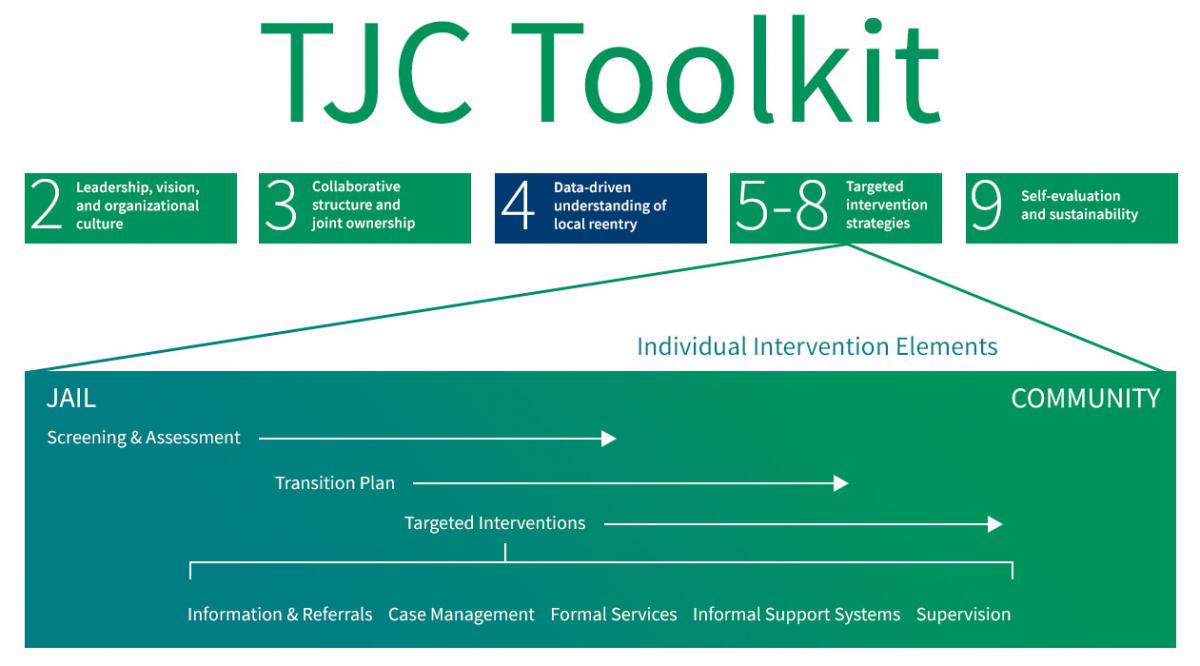
Welcome to Data-Driven Understanding of Local Reentry. This module provides you with information on the essential role reliable data plays in successfully transitioning people from jail to the community.
Sheriffs, directors, department heads, and commissioners all make dozens of decisions that commit resources, impact working conditions, and set in motion programs that will be in place for years to come. These decisions have the power to affect people's lives for good or for bad, so it is obviously important that they are based on the best information possible. 1
—Captain Randy Demory, Kent County Sheriff's Office,
Grand Rapids, Michigan
We all know that agencies within or related to corrections collect all types of information or data. For our purposes, we simply want you to ask yourself what information you need to develop effective jail transition interventions. What do you need to know about the jail population and their needs, and about the capacity of existing programs to meet those needs?
Before you begin, ask yourself how often your agency uses data to
- Improve your understanding of the risk and needs of people transitioning from jail to the community.
- Determine the resources available and accessible to meet their needs.
- Help develop strategic initiative plans.
- Monitor the success of the transition process.
- Allocate your resources wisely to realize the best possible organizational/system outcomes.
By the end of this section, you'll understand the importance of using a data-driven approach to inform your decisions and shape your responses. You will also begin to identify what data or information might be helpful to inform and evaluate your efforts.
This module has five sections and will take between 10 and 15 minutes to complete.
Recommended audience for this module
- Sheriffs
- Jail administrators
- Correction officers
- Jail treatment staff
- Classification and intake staff
- Community corrections staff
- Reentry coordinators
- Community providers
- Judges and Officers of the Court
- Social service providers
- Probation officers
- Pretrial services staff
- County board members
- Criminal justice council members
- Funders
- Local legislators
- Information technology staff working on the development of data systems
This module also includes a list of resources after each section to help in the process.
Module Objectives
In this module, you will have the opportunity to explore the importance of using a data-driven approach when implementing the Transition from Jail to Community (TJC) model in your community.
This module helps you to use data to examine key questions about reentry:
- What do we need to know to evaluate our jail population and improve their transition to the community?
- How can we get that information?
- What are the key outcomes we need to track?
This module has five sections:
- The Role of Data in a Reentry Effort
- Data Collection
- Management Information Systems
- Mining the Data
- Terms Used in the Field
By the end of this module, you will be able to
- Explain the importance of a data-driven approach to the TJC model.
- Identify the elements in a data collection process.
- Recognize the barriers to data collection.
- Discuss the benefits of a management information system.
1 Demory, R. (2001). Measuring what matters. Large Jail Network Bulletin. Washington, DC: National Institute of Corrections, p. 3.
Module 4: Section 1: The Role of Data in a Reentry Effort
This section will help you learn how objective information or data can inform, improve, and refine your jail transition process.
Data can answer questions about
- Characteristics of your population
- Who should be targeted for intervention?
- What crimes are most likely to cycle through your jail?
- What resources are available?
- How should scarce resources be allocated?
A data-driven approach to local reentry is the exact opposite of making decisions based on hunches, incomplete information, or a tradition of doing things in a certain way. Rather, such an approach analyzes objective information to inform decision making that results in measurable improvements in efficiency and outcome at the organizational and system level.
To begin, ask yourself
- What kinds of data do agencies in your community have?
- How can these data be used to improve the transition process from jail to the community?
- Who uses or has access to various data sources?
- What capacity is in place to develop, collect, maintain, and analyze these data?
- What factors influence whether and how data are used in the decision-making process at both the organizational and system level?
How do these analyses evaluate individual organizational decision making for alignment with system-wide, collaborative TJC goals or objectives? Accessing, collecting and analyzing local data are a first step to
- Confirm or refute perceptions about pressing issues.
- Monitor progress, measure outcomes, and formulate policies.
- Assess the characteristics of the jail population, local crime problems, laws, policies, and local resources.
- Identify issues, problems, and potential solutions for the jail population pre- and post-incarceration.
- Increase understanding of target populations of particular interest.
- Identify subsets of the population likely to consume disproportionate criminal justice and program resources.
- Identify geographic areas to which the jail population returns.
- Identify current community service providers that provide evidence-based services and identify gaps in available service necessary for people transitioning from jail to the community.
- Identify benchmarks and develop measures to chart progress toward them.
- Trace service referrals, engagement, and utilization, and share that information with partner agencies.
- Inform or implement improvements to your strategy.
- Identify resources that can be leveraged.
- Support sound decision making about policy and resource allocation.
For more information and examples from the field
1. Council of State Governments. (2005). Report of the Re-Entry Policy Council: Charting the safe and successful return of prisoners to the community. Relevant information on developing a knowledge base of information, including (a) understanding who is being released from prison, and (b) identifying what state and local policies influence and govern reentry. It also speaks to data issues for multiorganizational reentry initiatives like the TJC.
2. Elias, G. (2007). How to collect and analyze data: A manual for sheriffs and jail administrators. National Institute of Corrections. A comprehensive discussion on data collection, management, and analysis.
3. Howard County, MD. (n.d.). Map of Zip Codes to which Howard County inmates are returning. This is a useful tool in visualizing the communities’ individuals from the Howard County Detention Center are returning.
4. Allegheny County Jail Collaborative. (2019). 2018-2019 Annual Report.
4. Jannetta, J., & Ervin, S. (2022). Using data to change the use of jails: Implementation lessons from Charleston County, South Carolina, and St. Louis County, Missouri . Urban Institute.
5. Russo, M., Jannetta, J., & Duane, M. (2018). Using data dashboards to drive criminal justice decisions: An innovation fund case study from Allegheny County, Pennsylvania and San Francisco, California. Urban Institute.
6. Safety and Justice Challenge. (2024). Measuring Progress: Jail Trends in SJC Sites.
Summary
Collecting and analyzing local data is an important first step in developing an effective TJC effort. Data is necessary to help you analyze and identify issues and problems, inform improvements, monitor progress, measure outcomes, and formulate sound reentry policies.
Module 4: Section 2: Data Collection
This section helps you understand what data should be collected and used to make decisions. Agencies are often faced with one of two problems:
- Some agencies have only basic information about their population and available resources and start from scratch when developing their data collection systems.
- In contrast, other agencies are rich in data, but the data are not in a format that can be easily extracted, analyzed, shared, or presented in easy-to-comprehend reports.
To make matters worse, even when available, the data are often located in different electronic management systems (EMS) or separately on paper documents, which makes data integration nearly impossible. Rarely do agencies have the ability to share real-time data.
Regardless of which of these problems your agency has, the first step is to review management information systems, program records, and other data sources maintained by the jail, pretrial services, community corrections, the courts, and community partners to identify the characteristics and needs of their jail-involved clients, as well as the range of available resources in the jail and the community.
This information is critical to create a baseline understanding of the pre-TJC state, an accurate assessment of key issues, and the development of an appropriate set of integrated responses.
To begin, you will need to identify what data are presently available from the jail, pretrial services, community corrections, the courts, service providers, and other sources; in what format; and how confident you are in the data's reliability. We recommend that you begin by cataloging the following information:
- Name of each data source
- Information available from each source
- Data format (e.g., electronic, paper)
- Ownership of data
- How to access the data
- Restrictions on data
Once you have this baseline information, it is time to prioritize and develop a system to collect existing data from TJC stakeholder agencies or, as necessary, data not currently collected.
Pretrial Services Data
Data from pretrial services programs can be easily overlooked when planning reentry activities. But pretrial services programs gather a great deal of information about defendants which can be used to help develop effective jail transition interventions. Pretrial services are often the first entity to screen and assess the person and to develop a supervision plan. Pretrial staff also have relationships with providers in the community and can help you identify the health and human services available in your county.
Addressing the following six questions is the best way to begin collecting and using data.
1. What data needs to be collected?
At the individual level
- Individual characteristics: age, name, race/ethnicity, education, employment history, criminal justice history inclusive of current offense, physical and mental health needs, length of stay, risk and needs factors, program participation, and jurisdiction from which the individual came and will return to post-release.
- Capturing data on race and ethnicity is necessary to identify and address disparate outcomes. However, be aware that there are challenges to capturing this information accurately, particularly relative to Latino/a identity. [1]
- Subsets of the population that consume disproportionate criminal justice and program resources (e.g., frequent users, the severely mentally ill, and those with chronic diseases).
- Individual outcomes such as recidivism (inclusive of violations or probation or parole), attainment and retention of employment, access to health care, and/or maintenance of sobriety.
At the system level
- Your community's crime problems, locations of crimes, laws and policies that impede or facilitate successful transitioning from jail to the community.
- The availability and accessibility of services, gaps in services, fractured or unfunded services, data on programs, and resources that can be leveraged to support reentry.
- A better understanding of any racial and ethnic disparities in your system.
2. How can data be obtained?
- Intake, screening, and assessment files
- Program data from the jail, pretrial services, community corrections, the courts, and community agencies
- Self-administered surveys of clients or staff
- Interviewer-administered surveys of key stakeholders, service providers, and clients
- Focus groups
- Direct observations
3. Who is responsible for collecting the data?
- All system stakeholders: courts, pretrial services, probation, jail, police, treatment providers, and others
- Office of computer information services or local information technology (IT)/data management group/department
4. How confident are you that the data are accurate?
- Develop clear instructions and definitions about what is to be collected
- Identify who enters the data, both initially and on an ongoing basis
- Train staff on data entry and help them to understand the importance of accurate, ongoing data collection to the evaluation of TJC goals and objectives, both short- and long-term.
- Verify that the data appear to be complete
- Regularly evaluate the fidelity and accuracy of data, methods of collection, and the people collecting data
- Develop written policies, procedures, and guidelines in place to verify data quality
5. In what format will the data be collected?
- Electronically, via a management information system on a computer
- Paper based, such as case files and paper directories or documented accounts of personal interviews and phone surveys
6. How will you use the data you collect?
- Develop and disseminate easy-to-read reports
- Meet with staff to review results
- Based upon ongoing quality assurance efforts, identify necessary changes in policy and/or remediation to ensure adherence to same
Data Challenges
Data collection is often challenging, and you should be aware of the problems you might face. Chuck Shorter at Tulane University identifies the following barriers to collecting data: 1
- Lack of knowledge about where data exist
- Lack of knowledge about how to access data
- Data not in electronic form
- Data in an incompatible format
- Only aggregated data available
- Only individual-level data available
- Frequency of data release
- Approval process for accessing data
- Previous interactions and history of partnerships (e.g., lack of trust)
- Fear of misinterpretation/misuse of data
- Confidentiality and privacy concerns
- Policies, including federal and state laws that limit access
- Limited resources (e.g., staff time)
Fortunately, there are a number of ways to address these barriers. In general, as we discussed in the Collaborative Structure and Joint Ownership module, a reentry implementation committee can help gain trust and facilitate standardized data collection among partnering agencies. You might want to hire an IT consultant if you begin to find that the data systems you want to integrate are not compatible.
Finally, as was also discussed in the previous module, developing a Memorandum of Understanding (MOU) that includes a data-sharing agreement clause will ease fears of misuse of data.
For more information on data collection, click here for the Pre- and Post-Release Intervention Sections of the Triage Matrix Implementation Tool and the TJC Pre-Implementation Case Flow Process templates to begin your inventory of the interventions in the jail facility, at transition, and in the community.
For more information and examples from the field
1. Howard County, MD. (2013). Reentry Coordinating Council. This is a presentation to the Reentry Coordinating Council on who's in the jail.
2. La Crosse County, Wisconsin (n.d.) TJC case flow process diagram based on classification, Proxy screen scores and LSI-R assessment.
3. Montgomery County Department of Corrections and Rehabilitation. (n.d.) Confidentiality agreement: Montgomery County, Maryland, pre-release & reentry services.
4. New York State (2008). Summary of proposed MOU for facilitating data sharing among agencies participating in New York State’s TPC Initiative.
5. Rodriguez, N., & Tublitz, R. (2023). Exploring Latino/a representation in local criminal justice systems: A review of data collection practices and systems-involvement. University of California, Irvine School of Social Ecology.
5. Urban Institute. (n.d.) Short, eight-item questionnaire to identify if your agency collects the following criminal justice client data.
6. Urban Institute. (n.d.) A detailed list of suggested TJC baseline measures of jail population characteristics.
7. Urban Institute. (n.d.) TJC performance management worksheet. A detailed chart of TJC baseline measures of jail population characteristics in Excel format and a memo providing guidance to assemble the initial TJC performance indicators.
1Shorter, C. (n.d.) Barriers to accessing/sharing data. Presentation of the data sharing and access subgroup of the Center for Disease Control.
Summary
In this section you learned that it is important to thoroughly review what data are currently collected by your TJC partners. Staff and other agencies can help you to identify gaps in your current data collation systems, whether related to incompatibility or access or to data that are not collected currently. A data-sharing protocol can be best established through the use of memoranda of understanding as we have discussed herein.
Module 4: Section 3: Management Information Systems
This section provides an overview of management information systems and how this technology can assist in the collection and analysis of necessary data to understand reentry in your community.
A management information system (MIS), also referred to as an automated data system, is a computer system that enables you to record data in a systematic way and helps to manage all aspects of your agency. Ideally, an MIS can exchange data electronically with partnering agencies.
Some agencies do not have an MIS in place to record data and continue to rely on paper records, which can only be retrieved manually and are extremely time-consuming to analyze. Though an MIS requires training, support, and maintenance, its advantages far outweigh the time and resources it takes to implement it.
What MIS you decide to use is based on your agency's resources, expertise, and compatibility with other systems. Agencies that do not have the resources to purchase a database software package often use Microsoft Excel© or Google Forms when developing a database system.
A well-designed MIS has certain characteristics:
- Permits you to enter information once
- Assigns a unique identifier that follows an individual over time so records can be easily linked to other data systems across agencies.
- Facilitates data entry, access, and use
- Increases data accuracy
- Produces easy-to-read reports that are readily available
Picture an MIS that
- Collects individual data, including program participation, education, employment, and disciplinary problems.
- Examines classification scores of recidivists to assist with classification and program placement decisions for future incarcerated individuals.
- Assesses the differences in recidivism rates of program participants versus nonparticipants.
- Evaluates the effect of educational and employment programs as well as substance abuse and mental health treatment on recidivism rates.
- Identifies habitual misdemeanants at intake and prompts appropriate program referral.
- Produces easy-to-read aggregate and individual-level reports.
Data Quality Program
We all know the saying “garbage in, garbage out.” Your management information system’s (MIS) data will only be accurate if what you input is complete, accurate, and timely. Even the best structured MIS is useless if data are entered sporadically or incorrectly.
Developing a Data Quality Program can ensure data reliability. The following are important considerations when developing a Data Quality Program:
- Support an agency culture recognizing the importance of quality data collection
- Identify who is responsibility for data quality management
- Train data entry personnel and help them to understand the importance of their efforts
- Develop clear procedures for data entry (e.g., consistent definitions)
- Develop procedures when data errors are encountered
- Develop a process for regularly validating the data
Interagency Information Sharing and Protecting Confidentiality
An MIS is integrated when agencies (e.g., law enforcement, courts, pretrial services, jails, community corrections, medical providers, human service organizations, and community-based organizations) working with the same population have the ability to access and share information electronically. Having an integrated MIS in place increases the ability to provide continuity of care to individuals at time of release and evaluate the attainment of short- and long-term TJC goals that have been understood as essential by TJC stakeholders.
Agencies using an integrated MIS recognize the privacy concerns for the electronic tracking of an individual's sensitive personal information. Firewalls can be developed so only those who have permission and a password have access to the data. In addition, agencies can establish a unique identifier other than social security or a DOC number, which could help track the individual after discharge without the loss of privacy or increased stigmatization that could occur through use of a DOC number.
For more information and examples from the field
- Davidson County, TN Sheriff’s Office. (2010). Basic client information spreadsheet tracking housing status, program completion, case notes and other reentry items .
- Davidson County, TN. (2010). Client program and employment attendance spreadsheet records .
- Denver, CO. (n.d.) A detailed quarterly report tracking inmate outcomes, class attendance, referrals, demographics, and other reentry items.
- Denver, CO. (n.d.). Multi-party release of Information Consent Form (ROI). Crime Prevention and Control Commission Mental Health Committee. PowerPoint presentation and ROI form.
Summary
In this section you learned that a management information system is a computer system that enables you to systematically record data. Such systems minimize the need to record the same data multiple times, increase the accuracy of data, and facilitate meaningful data analysis. However, a management information system is only useful to TJC partners when, based upon accurate and consistent data entry, it generates reports that informs decision making to improve TJC outcomes and practices.
Module 4: Section 4: Analyzing Your Data
This section provides an overview of some key points to consider in developing analysis and reports from your collected data. Data can be very powerful. Just imagine having data on the number of jobs the formerly incarcerated held after being part of an in-jail employment program, and you were able to show that they had lower re-arrest rates over a 12-month period post-release than those who were not part of the job program. Politicians and funders like to support success stories that offer significant return on investment proven by valid and accurate data analyses.
After you evaluate the available data and begin to collect data needed to evaluate your efforts, data mining is the process by which you measure a variety of TJC outcomes, ranging from producing simple descriptive statistics - like how many men and women are substance abusers and the proportion of individuals in jail who are sentenced or pretrial detainees - to more complex analyses that may include comparing your data with other similar data at the state or national level. The goal, however, is to use the data you have collected to inform your agency and other stakeholders about where to put your transition resources and, eventually, how successful you have been transitioning people from jail to the community.
Randy Demory of the Kent County Sheriff's Office in Michigan has these data mining recommendations. 1
1. Plan Ahead: Centralize all of your data analysis efforts for easy retrieval, and designate a skilled person or a data team to handle all data requests. You will want to provide your data team with tools to pull data from the MIS in an easy-to-manipulate format that allows for the creation of basic tables like cross tabs.
| Outcome Category by Service Provider (Number and Percent) | ||||||||||
|---|---|---|---|---|---|---|---|---|---|---|
| Provider | Engaged 90 Days | Violated | Removed | Arrested | Total | |||||
| Provider A | 13 | 57% | 9 | 39% | 1 | 4% | 0 | 0% | 23 | 100% |
| Provider B | 20 | 69% | 3 | 10% | 3 | 10% | 3 | 10% | 29 | 100% |
| Provider C | 12 | 75% | 1 | 6% | 1 | 6% | 2 | 13% | 16 | 100% |
| Provider D | 14 | 64% | 3 | 14% | 4 | 18% | 1 | 4% | 22 | 100% |
| Provider E | 13 | 46% | 8 | 29% | 6 | 21% | 1 | 4% | 28 | 100% |
| Total | 72 |
| 24 |
| 15 |
| 7 |
| 118 |
|
| The table compares service providers' ability to keep participants engaged in treatment for 90 days after release from jail. | ||||||||||
2. Avoid Data Overload: Too many tables and numbers make people shy away from the data. Instead focus on using more charts and graphs, and produce only reports that are meaningful and directed toward what the partners need.
Howard County, Maryland’s Detention Center produces a monthly snapshot of its jail population. This assessable and easy-to-read information allows those interested to better understand how they can meet the unique needs of different jail subpopulations. Hennepin County, Minnesota's Crossover Population Report. Note that it is only five pages with easy-to-read tables and bullet points.
3. Measure What Matters: Use the data to help you define what is most important to your agency. The Kent County, Michigan Jail has focused on analyzing and disseminating the following types of data:
- Jail population statistics
- Jail population incident statistics
- Program performance data
- Employee performance data
Click here for Kent County Jail's monthly Performance Measures for the Main Jail, Community Reentry Center (CRC), and Honor Camp. These are items that Kent County reports each month to the Office of the Sheriff and quarterly to county administration as part of its performance-based budgeting process.
For example, the Kent County Jail reports the rate of violence in the Main Jail, since that is important to them. They also report the percentage of “productive residents” at the CRC and Honor Camp, with “productivity” defined as working or being in programs at least 20 hours a week. They track the numbers of people who are helped to find jobs. They also have a goal of meeting a certain number of active partnerships with community program providers, and they do meet that very easily each month.
Sober Unit Living Stats
110 Total Clients with Outcomes (year to date) | |||
|---|---|---|---|
| Average length of stay | 58 days | ||
| CT = Completed Treatment | 55 | 50.00% | |
| SD = Staff Decided to Remove | 5 | 4.55% | |
| ER = Early Release from Jail | 25 | 22.73% | |
| CD = Client Decision to Leave | 1 | 0.91% | |
| ERT = Early Release to Treatment Facility | 2 | 1.82% | |
| JD = Jail Staff Decision to Remove | 20 | 18.18% | |
| SP = Sent to Prison | 2 | 1.82% | |
Total | 110 | 100.00% | |
4. Require Flexibility: Train your data team to handle data requests beyond what the MIS software reports produce. This means that they will need to learn how to write queries of the system.
5. Produce Regular Statistical Reports: Determine what data reports your agency needs most. Decision makers should have access to daily, weekly, or monthly reports. An annual statistical report is also recommended to assess population characteristics and program change over time.
In Denver, routine data extracts from the Jail Management System and Reentry Database are reported, including client demographics, Proxy Triage Risk Screener scores, Level of Service Inventory (LSI) subscale and total scores (e.g., living situation, employment/education, and alcohol/drug problems) and the type and frequency of services utilized. Reports are also generated by the Life Skills Diversion Officers and the Community Reentry Project Case Managers. At the system-level, the data reports help Denver’s Sheriff Department strategize on the level of resources needed to implement jail transition. At the individual-level, the proxy and assessment results drive the development of appropriate treatment and discharge plans.
1 Demory, R. (2001). Measuring what matters. Large Jail Network Bulletin. Washington, DC: National Institute of Corrections.
Allegheny County Jail: Jail Data Unveiled
In an age of information transparency, a jail with a public data dashboard is more crucial than ever. An interactive platform empowers the community and stakeholders to see, understand, and engage with the jail’s work in real-time. Data, for example, on jail population, booking and release trends, and program involvement becomes accessible and digestible, fostering a more informed and involved public. Ultimately, this open data fosters trust and collaboration, making the jail’s work more responsive to the needs and concerns of the people it serves. Check out Allegheny County, PA Jail Population Management Dashboard
For more information and examples from the field
1. Denver Sheriff Department (n.d.). Risk/need screening and assessment pilot overview.
2. Denver, CO. (n.d.) A detailed quarterly report tracking inmate outcomes, class attendance, referrals, demographics, and other reentry items.
3. Denver, CO. (n.d.). Denver jail to community reentry case management form.
4.Hennepin County, MN. (2013). Hennepin County Transition from Jail To Community crossover population.
5. Howard County, MD. (2013). Reentry Coordinating Council. This is a presentation to the Reentry Coordinating Council on who's in the jail.
6. Kent County, MI. (n.d.). Correctional facilities performance indicators.
Summary
In this section you learned that data mining is a process of analyzing data to determine patterns and relationships. When done effectively, data mining can inform your agency and stakeholders where transition resources are needed and how successful your transition program has been.
Module 4: Section 5: Terms Used in the Field
This section defined a number of basic terms used in this module. These terms have been highlighted in purple throughout the module, allowing you to rollover the term to see the definition.
Data:
A recording of facts, concepts, or instructions on a storage medium for communication, retrieval, and analysis.
Data-driven process of local reentry:
The process of collecting and analyzing data to make appropriate decisions when transitioning individuals from the jail to the community.
Data mining:
The “process of analyzing data in order to determine patterns and their relationships.” 1
Management information system:
“An information collection and analysis system, usually computerized, that facilitates access to program and participant information. It is usually designed and used for administrative purposes.” 2
Primary data:
Original data obtained directly from individuals through screening, assessment, surveys, interviews, or focus groups.
Secondary data:
Useful data already collected for another purpose, such as health records and resource information.
1 Biere, M. (2011). The new era of enterprise business intelligence: Using analytics to achieve a global competitive advantage. IBM Press.
2 Bureau of Justice Assistance, Center for Program Evaluation and Performance Measurement (CRPPE).
Summary
Now that you have completed this section, you understand key terminology that is used in this module.
[1] Rodriguez, N., & Tublitz, R. (2023). Exploring Latino/a representation in local criminal justice systems: A review of data collection practices and systems-involvement . University of California, Irvine School of Social Ecology.