



Module 8: Targeted Transition Interventions
This visual indicates where Tailored Intervention Strategies fits in the Transition from Jail to Community model.
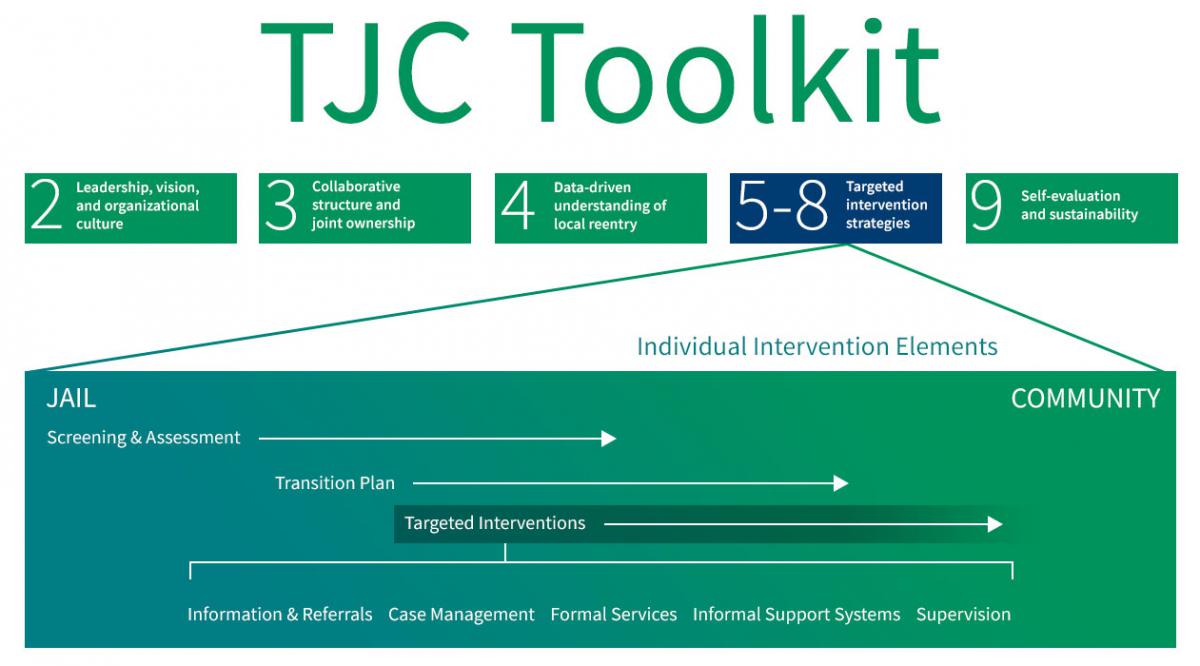
Welcome to Targeted Transition Interventions. This module concentrates on the development and implementation of evidence-based jail transitional strategies and follow-up services in the community.
Your jurisdiction's targeted interventions may range from comprehensive, evidence-based programs that transition the individual from the jail to the community to far less intense activities such as the distribution of resource packets or making simple referrals to community-based providers.
Some interventions will occur in jail, while others will take place in the community after release. However, for intensive transition planning and treatment, it is desirable that many interventions will be available both in and outside the jail facility. For higher risk people, such a structure allows for the treatment dosage necessary to effect behavioral change; as treatment begins early during incarceration and continues with continuity with a community-based provider immediately upon release.
"Responding to the reentry needs of incarcerated individuals requires a comprehensive, multi-systems approach that starts at sentencing and continues in the community after release. It's essential to systematically and objectively determine needs that may cause them to reoffend and then directly match clinical and community-based resources to those needs. Courts, probation and parole, correctional facilities, medical and clinical providers and community resources must work together to create a continuum of effective programming behind the wall and in the community to ensure truly corrective services."
—Levin Schwartz, LCSW
Director, Clinical and Reentry Services, Franklin County Sheriff's Office
Franklin County, Massachusetts
This module has five sections and will take between 10 and 15 minutes to complete.
Recommended audience for this module
- Sheriffs
- Jail administrators
- Correction officers involved in transition efforts
- Jail treatment staff
- Pretrial services staff
- Community corrections staff
- Reentry coordinators
- Community providers
- Social service providers
- Probation officers
- County board members
- Criminal justice council members
- Judges and officers of the court
This module also includes a list of resources to help in the process.
Module Objectives
In Module 5: Targeted Intervention Strategies, you learned about the 11 tasks outlined in the Targeted Intervention Strategies section of the TJC Implementation Roadmap and the importance of using the risk-need-responsivity model to determine the appropriate strategies to address an individual's criminogenic factors pre- and post-release.
The purpose of this module is to identify jail and community-based intervention strategies to address the risks and needs of pretrial and sentenced incarcerated people. Interventions can be as simple as providing resource packets before release or as comprehensive as intensive jail transition planning, working with case managers and treatment providers both during time in custody and within the community to develop evidence-based transition/treatment plans beginning while in custody and continuing after release into the community.
In this module, you will have the opportunity to explore tasks 6 through 11 of the Targeted Intervention Strategies section of the TJC Implementation Roadmap.
Task 6. Define scope and content of jail transition interventions currently in place.
Task 7. Provide resource packets for all jailed individuals upon release.
Task 8. Deliver in-jail interventions for selected individuals.
Task 9. Deliver community interventions for selected releases.
Task 10. Provide case management for selected jail entrants.
Task 11. Provide mentors for selected jail entrants.
This module has five sections:
- Identifying Your Present Interventions
- Resource Packet Development
- Delivering In-Jail and Community Interventions through Evidence-Based Curriculum
- Incentivizing Program Participation and Support
- Terms Used in the Field.
By the end of this module, you will be able to
- Define the scope and content of jail transition interventions currently in place.
- Create resource packets.
- Deliver in-jail and community interventions to targeted populations.
Module 8: Section 1: Identifying Your Present Interventions
This section will help you first identify the current jail and community transition intervention programs currently in place and then determine gaps in service. This is a starting point in any intervention process and is useful for the following reasons:
- Helps you to understand service availability and accessibility
- Helps you identify gaps in services
- Assists in evaluation of new resources and/or approaches
- Helps to understand the amount of services, both in custody and within the community, needed to address the needs of targeted populations
- Improves responsiveness
- Improves system continuity
- Helps jails and service providers coordinate their interventions
- Gives you information to develop resource guides
Intervention examples
- Resource information and referrals
- Courses
- Training sessions
- Formal services, treatment, and training
- Case management
- Mentoring
- Supervision
You will want to briefly describe the type of interventions available, the client and staff type, and when and where the intervention takes place.
Next, use other sources to add to your inventory. These can include the following:
- Health and human service resource guides are available in most cities and counties. The United Way or government agencies publish these guides, which often focus on a particular need, such as homelessness, HIV/AIDS, or job training.
- Partnering agencies and stakeholders, discussed in the Collaborative Structure and Joint Ownership module, have a wealth of knowledge on available services.
- The presently and formerly incarcerated are often willing to assist in understanding system efficiencies and gaps in service. Consider convening several focus groups of recently released individuals and others released some time ago, and ask them directly which resources were helpful and which were not.
Do not assume that all the information you receive is accurate and current.
- All services must be contacted before being listed in your final inventory and should be contacted every six months to verify the information.
- Some service providers will tell you they provide multiple programs, when the reality is they mainly refer clients to other services.
- Make sure to question providers on the specific programs they offer to determine their adherence to evidence-based principles that are essential to the success of your local TJC efforts and their eligibility requirements and capacity.
- Services not meeting the needs of the jailed and formerly incarcerated or not consistent with known best practices should be deleted from the database and alternative agencies sought.
The following are categories that might be included in a community inventory of evidence-based service providers:
| Service Provider Database Categories | |
|---|---|
| Agency name | Appointment required |
| Program name | Referral required |
| Services provided | Language(s) spoken |
| Address | Eligibility requirements |
| Contact person | Program exclusions |
| City, state, zip code | Space availability |
| Neighborhood or geographic zone | Documents required |
| Phone number | Fee structure |
| E-mail address | Other information |
| Web site address | Date agency first contacted |
| Fax number | Date agency information last updated |
| Hours and days of operation | Comments |
| Weekend days and hours | |
Finally, develop a database that inventories programs in the jail and the community to better manage available services and help you identify any gaps or lack of continuation of services from the jail to the community.
Provided here is a template of a jail- (J) and community-based (CB) service and treatment inventory table. You will want to revise the template based on the service availability in your community. However, the 29 interventions listed are the most common services offered and found useful by those transitioning from jail to the community.
Conducting a case flow analysis
Many communities conduct a case flow analysis to take an inventory of the resources available and evaluate the resource gaps in their community. Such an analysis involves community agencies, corrections, pretrial services, probation, the courts, parole, social work agencies, and the incarcerated themselves in the cataloging of available information and data and to identify and, as available, fill in any community resource gaps. Allow all participants to include what information, data, and/or community resources that do not presently exist; but that they would find valuable to help transition people from jail to the community.
The process of conducting a case flow analysis is as follows:
- Identify who will be responsible for developing the case flow analysis.
- Develop a standardized template for all partners to fill out.
- Make it available electronically to facilitate dissemination and easy updating.
- Solicit partner input during the meeting and/or through a survey.
- Emphasize the importance of partners being open about what resources they do and do not have.
- Develop the case flow report.
- Use the information to identify gaps in service and/or resources and make recommendations.
The following questions and TJC Pre-Implementation Case Flow Process templates attached to them are designed to help you start this process. We include four blank Case Flow Process templates for your own analysis. No two jail systems are alike, so make sure to modify the questions and templates to fit your needs.
Under each template, we also provide an example from one county to help you understand how the tables might be completed. Remember that these examples are pre-TJC implementation, so the goal here is to observe how one county filled in its information given the resource gaps facing this particular county.
We hope this promotes more discussion in your own county. For example, in the Case Flow Process In-Jail Services and Treatment Programs County Example, the county acknowledges that no anger management programs are offered because of a lack of volunteers. This is the type of detail you will want to include in your own analysis to help the reentry implementation committee understand the present process, how individuals are presently flowing through the system, and ways to improve the process.
1. Screening and Assessment Key Questions
- What screens and assessment instruments are used?
- What type of individuals are screened and assessed?
- What percentage of the total population is screened and assessed?
- At what point in the criminal justice process is this done?
- How will screening and assessment help to determine interventions?
- Is treatment based on the risk and needs level identified from assessment instruments?
- Who is responsible for completing the assessments?
- Is assessment information shared with staff in the facility?
- Is assessment information shared with community agencies and other system stakeholders?
- How are assessment data stored?
- Are assessment data analyzed?
- Who makes decisions based upon data analysis?
- What gaps do you see in the present system?
- What are the strengths of the current system?
Click here for Case Flow Process: Screening and Assessment Template and County Example
2. Case Management Services Key Questions
- How does an individual “enter” the case management system?
- Does screening and/or assessment contribute to case management?
- What are the key intervention decision points as an individual moves through your jail-to-community system?
- How is an individual's movement in and through the system (case flow) monitored or tracked? Is this information entered into a database?
- How do court-ordered services match with practices associated with needs-driven targeted case planning?
- How is an individual's movement/compliance with court-ordered services tracked?
- What information are providers expected to report? How often?
- How are referrals and utilization captured in the system?
- How is this process coordinated with community providers?
- Have interventions assigned routinely by the courts, community corrections, or the jail as part of a routine case management practice or policy been determined to be evidence-based?
- What are the gaps in the present system?
- What are the strengths of the current system?
Click here for Case Flow Process Case Management Services Template and County Example
3. In-Jail Treatment and Transitional Programs Key Questions
- How is movement into programs determined?
- Is there good coordination between the jail and community provider staff?
- Do in-jail programs match community-based programs on approach or curriculum?
- Have in-jail and community programs been evaluated rigorously and deemed evidence-based?
- What is the referral process?
- Are individuals linked to the same providers they worked within the jail as they reenter the community?
- Is there a central classification system that considers reentry case flow?
- Is risk to re-offend information used in concert with objective jail classification information?
- Does jail classification prevent groups of individuals from utilizing transition services?
- How are individuals solicited to participate in programs?
- How is movement into programs determined?
- Does screening and/or assessment drive the program/intervention assignment?
- Is a standardized means or method utilized to identify or solicit offenders equally, regardless of sanction, placement, or any other factor?
- What is the primary focus and goal of transition programs?
- Is programmatic information provided to community providers? How?
- How are data collected to monitor and evaluate this process?
- What are the major gaps in this system at present?
- What are the strengths of the current system?
- How is success measured?
Click here for Case Flow Process In-Jail Services and Treatment Programs Template and County Example
4. Community-Based Treatment Key Questions
- When individuals transition to the community, are they linked to the same providers they saw in the jail?
- For individuals needing multiple services, who coordinates services across providers?
- Do programmatic initiatives within the community match similar initiatives offered within the jail?
- Is there good coordination between jail and community management and staff?
- Does jail treatment or transition staff remain engaged in the process and “reach out” to community providers to assist community programs and enhance program continuity?
- What is the referral process from jail to the community provider?
- Does programmatic information flow to and from community providers?
- Are universal case plans available and/or shared?
- How are data collected to monitor and evaluate this process?
- What are the major gaps in providing transitional service from the jail to the community at present?
- What are the strengths of the current interagency collaborations?
Click here for the Case Flow Process Community-Based Treatment Template
Once the case flow process is completed, have the reentry council review the case-flow tables to discuss how individuals are presently flowing through the system and identify ways to improve the process.
Key considerations when evaluating the information obtained from the case-flow analyses:
- What are the characteristics of the higher-risk clients you are trying to serve?
- What are the goals of each program and how will goal attainment be measured and evaluated?
- How do the goals of individual programs or stakeholders fit with the goals of the TJC system at large?
- How long will clients be in jail?
- What services can be provided within the jail facility based on average length of stay?
- Does the program dosage and intensity compare to that of similar evidence-based programs?
- What is the proper program dosage needed both in custody and within the community?
- How will in-jail interventions be linked to community-based interventions?
- Will there be a coordinated plan and curriculum?
- Does the curriculum have to be delivered in sequential order (e.g., do you have to start at lesson 1, or can you come in at lesson 10)?
The case flow tables should also help you understand the following issues:
- The pre-initiative process by which the jail population interacts with each partnering agency
- How the community serves the jail population
- Resources needed to fill identified gaps and/or change existing practice
For more information and examples from the field
1. Allegheny County, Pennsylvania Department of Human Services. (n.d.) Cover letter. A template of a cover letter and a self-report questionnaire you can send to agencies requesting information about their services. The questionnaire was adapted from a survey developed by the Department of Human Services, Allegheny County, Pennsylvania.
2. Davidson County, TN Sheriff’s Office. (n.d.). Davidson County in-jail program target populations.
3. Kent County, MI. (n.d.). TJC pre-implementation case flow maps : Screening and assessment, case management services, in jail services and treatment programs, transitional programs, and community-based services and treatment programs.
4. Urban Institute. (n.d.). Jail transition in “your” county. A questionnaire that you can send to different stakeholders in your community, including the formerly incarcerated, to better understand their perceptions of the barriers that impede individuals from receiving services.
5. Urban Institute. (n.d.) In custody client flow chart.
Summary
In this section, you learned that by making a detailed inventory of all jail-based, transitional, and community interventions, you can clearly identify the programs that are currently in place and determine any gaps in service delivery. Templates were provided, including a self-report questionnaire for agencies, a survey of stakeholders' perceptions of transitional barriers, and a completed intervention inventory.
Module 8: Section 2: Resource Packet Development
Transition plans need to be written at a reading level the average incarcerated person can understand. Many of those in jail read between the fifth- and seventh-grade levels, so consider that when developing your transition plans.
An easy way to measure the readability of your reentry plans is to use the Flesch Reading Ease readability assessment software, available in Microsoft Word. The following directions explain how to access these readability statistics when using Microsoft Word:
- Go to “File” in the ribbon menu and select “Options.”
- Select “Proofing” in the dialog box that pops up; scroll down to view the “When correcting spelling and grammar in Word” area, and make sure the “Show readability statistics” box is checked.
- Now that Word is set to check readability statistics, select “Review” in the ribbon menu, and select “Spelling & Grammar” on the left side of the ribbon menu. Word will now check grammar and spelling throughout the document and ask you to approve its suggested revisions.
- After it completes checking spelling and grammar, it will display a dialog box with readability statistics. The relevant number is the “Flesch-Kincaid Grade Level.”
After Microsoft Word checks for spelling errors, it will display information about the reading level of the document.
This section will help you create resource packets or guides to empower those incarcerated to use services while in jail and after release. You will also learn the best way to distribute the guides, including training for jail staff.
The development of a user-friendly county- or city-specific resource brochure, pamphlet, or pocket-size resource guide will help the returning population and their families understand the community resources available to meet their needs.
The content of resource brochures and guides ranges from listing the most important numbers and hotlines to providing a description of the challenges individuals face at release and helpful tips to manage them.
Resource packets are important to :
- Link those leaving jail to interventions that can help them.
- Help jail staff gain a better understanding of community services when assisting incarcerated and formerly incarcerated individuals.
- Provide an easy guide for the formerly incarcerated when they are released.
Following are 12 recommendations for the development of reentry guides:
- Provide an honest and hopeful introduction.
- Provide letters of support and sponsorship from other formerly incarcerated individuals.
- Prioritize crucial first steps and include a reference list for less immediate issues.
- Incorporate the guide into a training curriculum with in-person support.
- Provide the guide well ahead of release to help prepare a smoother transition.
- Include content that helps to manage specific challenges.
- Include maps of cities, transportation routes, and the locations of major service providers.
- Include informative, motivational text, being conscious of prevalent literacy levels.
- Include only service providers committed and accessible to individuals with a history of involvement in the criminal justice system.
- Be sensitive to language barriers.
- Keep the guide small, portable, and discreet.
- Evaluate reactions before and after the publication of the guide.
Read more details about each recommendation.
Benefit Boards and Online Community Resources Databases
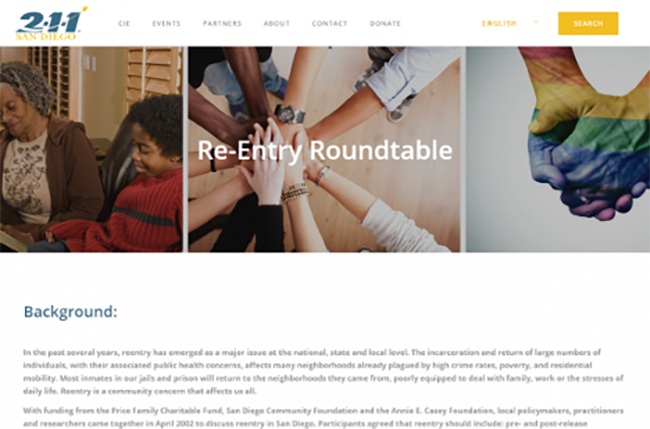
Benefit boards located throughout your facility and online community resource databases are easy and effective ways to share resources for those transitioning back to the community. The San Diego County District Attorney's office , San Diego County Sheriff's Department , San Diego County Probation Department , and San Diego Re-entry Roundtable developed in partnership 2-1-1 San Diego, a reentry section on the 2-1-1 website: http://www.211sandiego.org/Re-entry .
San Diego's 2-1-1 Post Incarceration Re-Entry Resources |
 |
For more information and examples from the field
Following are examples of different types of resource materials for people transitioning from jail and prison to the community.
1.Cuyahoga County, Ohio. (2011). Going home to stay: A guide for successful reentry for men and women.
2. Davidson County, TN Sheriff’s Office. (2008). Re-entry packet and information and referral guide.
3. Douglas County, KS. (n.d.). Reentry resource list with map and bus routes.
4. Howard County, MD. (n.d.). Howard County Probation reporting information sheet.
5. Douglas County Sheriff’s Office Corrections Division. (n.d.). Crisis resource card.
6. Fishman, N. & Mellow, J. (2008). The Essex County Smart Book: A resource guide for going home . The New Jersey Department of Corrections. This guide will give you a better idea of information you may want to include in a resource guide. Revised 2019 by the New Jersey Department of Corrections.
7. Howard County, MD. Dept. of Corrections Reentry Program. (2014). Howard County reentry Xpress session outline.
8. Orange County Sheriff’s Department Inmate Service Division. (n.d.). Client release guide: A guide to food, shelter & other emergency services in Orange County.
1Mellow, J., & Dickinson, J. M. (2006). The role of prerelease handbooks for prisoner reentry. Federal Probation, 70(1), 70–76.
Summary
Identifying the community resources available and accessible to individuals transitioning back to the community is critical for successful reentry. Resource guides link incarcerated people to helpful interventions and inform jail staff of existing community services.
Module 8: Section 3: Delivering In-Jail and Community Interventions through Evidence-Based Curriculum
This section explains the process of developing and delivering interventions through an evidence-based curriculum to selected people in the jail and upon release to the community. Interventions can include short courses, training sessions, formal services, and treatment programs. Whenever possible, the program and services offered in the jail should mirror or work in conjunction with community programs, ideally by the same provider in and out of the jail.
Course selection must consider
- The individual's length of stay
- The level and type of criminogenic risk and need that will be targeted and serviced
- Group space and staff who can deliver the curriculum
- Training needs of staff to deliver the curriculum
- Alignment with existing programs and services both in jail and the community.
Work done while in jail to begin treatment, develop relationships with service providers, and connect individuals to service appointments in the community will have less impact after release if there is no follow-up in the community. Community-based organizations and support networks must provide continuity of care—or in many cases, initiate care—through services, training, treatment, and case management when an individual is released.
There are five basic steps to developing and delivering interventions.
Step 1: Determine which individuals should receive which interventions.
The eligibility for participation in any in-jail and community-based intervention is based on a thorough risk/needs assessment, a completed transition plan, and the individual's length of jail stay. Secondary considerations include jail and community capacity, staff availability, staff training, financial resources, and receptivity of the incarcerated population.
Guided by evidence-based, best practices, lower-risk individuals with few needs do not receive comprehensive interventions but still have access to less intensive referrals and services in the jail and the community.
Higher-risk individuals with many needs should receive the most comprehensive interventions available at the jail and upon release.
Click here for a table that outlines the type of in-jail and community interventions available to a person based on his or her risk and needs and length of stay in the facility or program. As you see, the longer the length of stay, the more interventions are available in the jail setting.
Step 2: Select interventions.
After you identify your population needs, it's time to define the content and curriculum of evidence-based short courses, training sessions, formal services, and treatment programs designed to reduce recidivism.
Research shows that certain interventions have the greatest impact on recidivism rates for correctional populations. The following are five major areas of treatment:
- Cognitive behavioral/life skills groups
- Substance abuse groups/ CBT substance abuse treatment
- Job readiness and employment
- Educational programs
- Housing and community reintegration planning
We recommend that you enlist programming experts, such as those listed below, to suggest evidenced-based interventions for your population:
- Psychologists
- Correctional researchers
- Staff from institutes and government agencies
- Consultants
- Other jail facilities
These experts understand the importance of evidence-based interventions and will be helpful in discussing with you which interventions are backed by research proving their effectiveness. They should also be able to help you to understand the research and build capacity within your own organization to evaluate programs and services and ensure that you utilize only those programs or services that are proven to be effective. You can often locate them by contacting
- American Correctional Association
- American Jail Association
- American Probation and Parole Association
- Substance Abuse and Mental Health Services Administration's Center for Behavioral Health and Justice Transformation (GAINS Center)
- National Institute of Corrections
- Colleges and universities
- Community-based organizations
Remember, regardless of whom you work with, make sure to have them show you why and how their intervention or treatment is evidenced-based. Ask if any empirically based studies have provided statistically significant evidence of the effectiveness of their treatment, program, or intervention. Guidance is offered by organizations such as the NIC to help you with this task including training , information and technical assistance.
Step 3: Pilot the new intervention.
Pilot testing your program on a small group before extending the intervention to all individuals who meet the criteria is necessary for the following reasons:
- It allows you to identify which factors helped or hindered implementation of the intervention before you spend a large amount of time and money on the intervention.
- It allows you to determine whether staff are adequately trained, and if not, gives you time to help them improve the delivery of the intervention.
Step 4: Implement the intervention.
High-quality implementation of the intervention is the next step. An evidenced-based curriculum alone does not guarantee successful implementation. Your organization has to be “ready” and have the capacity to meet the challenges of implementing a new program. The following factors influence high-quality implementation: 1
- Staff selection
- Pre-service and in-service training
- Ongoing consultation and coaching
- Staff training and evaluation
- Facilitative administration
- System interventions
Read more details about each implementation factor.
Step 5: Extend the new intervention to all individuals who meet the criteria.
Moving to a full-scale implementation of the intervention occurs once the pilot program has been determined to be successful. Of course, once you have fully implemented the program, your work to develop effective transitional services is not complete. Developing and delivering evidence-based interventions is an ongoing, iterative process. In Module 9: Self-Evaluation and Sustainability, you will learn methods for continually evaluating your progress and ensuring that you are delivering the most effective and valid interventions.
Developing programming curriculum that is responsive to women
Programming should be designed with women’s specific pathways to incarceration in mind, providing interventions that address issues related to pathways, including substance use, mental health, prior trauma, parental responsibility, and interpersonal relationships.
Evidence shows that responsive programming can lead to positive outcomes for incarcerated women such as:
- Reduced symptoms of anxiety, depression, PTSD, and other mental health issues
- Lower rates of substance use
- Reduced likelihood to recidivate
- Improved participation in treatment
- Improved interaction with dependent children
- Decreased risky sexual behavior
- Reductions in behavioral problems
- Increased coping skills
- Improved self-esteem
Women require different programming than men in jail custody. There are many responsive programs for incarcerated women that have been evaluated over the years. The below table provides descriptions of programs from their websites that you may consider offering for women under your custody.
| Program Name | Brief Description |
| Beyond Violence: A Prevention Program for Criminal Justice-Involved Women | Manualized curriculum with 20 sessions focused on addressing histories of anger, aggression, and violence. The program uses a four-level model of violence prevention, relying on 1) individual, 2) relationship, 3) community, and 4) societal factors. The program uses different therapeutic strategies, including psychoeducation, mindfulness, and cognitive behavioral restructuring. |
| Healing Trauma: A Brief Intervention for Women | Brief, trauma-informed intervention for incarcerated women that implements an approach focused on strengths and empowerment to understand abuse experienced and how it has affected their lives. The program uses a psychoeducational, cognitive-behavioral approach. |
| Helping Women Recover: A Program for Treating Addiction | Program focused on addressing four modules related to addiction: 1) the self, 2) relationships, 3) sexuality, and 4) spirituality. The program also addresses issues of self-esteem, sexism, family of origin, relationships, domestic violence, and trauma. |
| Moving On: A Program for At-Risk Women | Based on cognitive behavioral therapy, relational theory, and motivational interviewing, this program helps participants improve communication and emotional regulation skills . The program focuses around four themes: 1) personal responsibility and motivation for change; 2) connections and building healthy relationships; 3) skill enhancement; and 4) relaxation and stress management skills. |
| Seeking Safety | Using a cognitive behavioral approach, this program supports people working to seek safety from trauma and/or substance abuse, and people looking to develop coping skills. |
| A Woman’s Addition Workbook: Your Guide to In-Depth Healing | Self-guided workbook for incarcerated women with substance use disorders and other addictions that focuses on dual diagnosis, trauma, and violence. |
In addition to the responsive programming listed above, it is important to offer parenting programs for incarcerated women. Parenting programs help women who are incarcerated get the tools they need to be more effective parents and build or sustain positive relationships with their children. Programming that is responsive to women can include therapeutic elements that address trauma parents and their children have experienced, help parents work through emotions in healthy ways to reduce instances of child abuse and neglect, and provide resources to strengthen family and community connections for emotional support.
The only evidence-based parenting program specifically designed for criminal legal system-involved parents is Parenting Inside Out (PIO) . PIO is the largest parenting program available in the United States and has been implemented in 45 states and served 15,000 parents to date.
The San Diego County Sheriff's Department (SDSD) opened Las Colinas Detention and Reentry Facility (LCDRF) in 2014. It is the only facility that houses female incarcerated persons in San Diego County. Ensuring that this facility was responsive was a priority, and the facility's design, staff training, policies and procedures, and service delivery reflects this intention through some of the following practices:
- Facility designed with women in mind: natural light, murals, visit rooms for mothers and children, and expansive classroom space
- All professional staff, volunteers, and contracted professionals required to receive training on responsive approaches in corrections
- Vocational programs tailored to meet the needs of women, including culinary arts, landscaping & horticulture, and industrial sewing. All vocations offer the opportunity to earn college credits and some type of formal certification
- Educational programs including G.E.D., college classes in partnership with local community college, and a computer literacy course
- Trauma-informed treatment curriculums, including Healing Trauma and Anger Beyond Violence
- Programs offered to allow mothers to read children’s books on camera to be sent to their children and guidance on age-appropriate literature for children
- Correctional counselors work with women to develop reentry plan and obtain California ID, birth certificate, and library card
- Resource fairs and conference-like events featuring workshops and presentations
For more information and examples from the field
1. Finn, P. (1997). The Orange County, Florida, educational and vocational programs ,National Institute of Justice Program Focus. A recommended resource on how programs can be implemented in your jail.
2. Fleming, E., Upton, A., Lopez Wright, F., Wurzburg, S., & Ney, B. (2021). Adopting a responsive approach for women in the justice system: A resource guide. The Council of State Governments Justice Center.
3. Fresno County, CA. (2013). Fresno County Transition from Jail to Community (TJC ) housing unit position descriptions for Unit Sergeant and Correctional Officer Job.
4. Kates, E., Mignon, S., & Ransford, P. (2008). Parenting from prison: Family relationships of incarcerated women in Massachusetts. Center for Women in Politics & Public Policy.
5. Kent County, MI Sheriff's Office. (m.d.). Reentry program schedule of classes.
6. La Crosse County, WI. (n.d.). Thinking for a Change training. Training flyer for system stakeholders.
7.Orange County, CA Probation Department. (n.d.). Orange County transitional reentry center orientation handbook.
8. Petrillo, M., Thomas, M., & Hanspal, S. (2019). Healing trauma evaluation report. University of Portsmouth.
9. Stuart, O., & McCoy, E. F. (2023). Responsive programming in women's prisons. Urban Institute
10.Sullivan County, NH Department of Corrections. (2011). Community corrections program schedule of programs and services.
11. Urban Institute. A table of different cognitive-behavioral, substance abuse, fatherhood, and staff curricula, including cost and number of classes required.
12. Urban Institute. (n.d.). A table of educational programming available through satellite TV and other distance learning techniques.
13.Urban Institute. (2011). TJC Intervention Inventory (LSI-R Version).
1 Denton, C. A., Vaughn, S., & Fletcher, J. M. (2003). Bringing research-based practice in reading intervention to scale. Learning Disabilities Research & Practice , 18(3), 201–211.
Summary
In this section, you learned the five basic but necessary steps to develop and deliver evidence-based interventions. You learned that it is important to receive advice from programming experts, as well as to pilot-test intended interventions.
Module 8: Section 4: Incentivizing Program Participation and Support
This section aims to help you understand how to support prosocial behavior through incentivizing program participation and mentoring. Often, the target population for in-jail and community interventions is resistant because of long histories of failed efforts in programs and ambivalence about change.
As Former Deputy Commissioner Kathleen Coughlin of the New York City Department of Corrections notes, incarcerated people have been disappointed numerous times before by the criminal justice and social service systems, and they are both “program-weary” and “program-wary.”
Your recruitment and retention efforts must take into account this resistance to programming, because limited outreach will undoubtedly result in low participation and completion rates.
Research indicates that incentives can motivate people to sign up and complete programs.
In-Jail incentives
- Increased visitation
- Later curfews for work release individuals
- Later lock-in times
- More phone access
- More recreation time
- More television
- Movie nights
- Access to more television channels
- Certificates of completion
- Letters of recognition
- Graduation ceremonies
- Improved housing assignments
- Extra or early movement into community corrections
- Good-time credits
- Extra Food or snacks
- Juice machines
- Microwave
- Hand Sanitizer
Community-Based incentives
- Bus passes
- Access to phone cards
- Food vouchers
- Special activities for people who participate in programs – donated by the community
- Housing
- Family reconciliation efforts
- Certificates of completion
- Letters of recognition
- Being asked to serve as a mentor to other formerly incarcerated individuals
- Reduction of supervision conditions
- Early termination of supervision
- Community recognition
Mentoring
Mentoring can help with successful reintegration by providing positive role models to people returning to the community. Ideally, individuals are paired with mentors during custody, with the intent of maintaining the relationship in the community after release. It is important to note that if the formerly incarcerated are to be considered for this purpose, they must be well past their own criminal issues and have demonstrated consistent prosocial behavior over a significant period of time (generally understood to be a minimum of one-year).
Though each mentor/mentee relationship is different, a successful mentor will have the following attributes:
- Good listener
- Positive role model
- Has good boundaries
- Communicates effectively
- Understands the time commitment
- Patient
- Has knowledge and resources to help solve problems and address needs, within appropriate limits
- Clear on the role and what they can and can't do (i.e., they know they're not a case manager)
- Maintains contact and provides updates with the agency overseeing the mentoring program
Peer mentoring by previously incarcerated individuals or those in recovery who have turned their lives around and have maintained a prosocial lifestyle for an extended period since their offense can also serve an important role in the transition process. In fact, research has found that support from recovering peers may be more effective in reducing recidivism than support from clinical staff or correctional officers. 1
You can't beat the credibility of an ex-offender when trying to show offenders how their lives can be different. They can look a prisoner in the eye and say, “I have been in your shoes.”
—Sheriff Michael Hennessey
San Francisco Sheriff's Department
Training
Developing a mentoring program takes time, and a training program is required to teach volunteers how to mentor people while they are incarcerated and after release.
Following are a few recommendations:
- Screen all mentors to ensure they have the appropriate demeanor, time commitment, and motivation to dedicate a minimum of one year working with a mentee.
- Provide a mentor training program that integrates mentoring with other TJC approved interventions and treatments.
- Provide ongoing support during the mentorship.
For more information and examples from the field
1. National Mentoring Partnership : Expanding the World of Quality Mentoring. Mentoring resources and information in the Program Resource section of this website.
2. Substance Abuse and Mental Health Services Administration (SAMHSA). (2006). Successful strategies for recruiting, training, and utilizing volunteers: A guide for faith- and community-based service providers.
3. San Diego County, CA. (2015). San Diego County presentation on Las Colinas Reentry Facility client flow.
4. Fresno County, CA. (n.d.). Fresno County TJC unit guidelines and procedures (incentive structure described therein).
1Wexler, H. K. (1995). The success of therapeutic communities for substance abusers in American prisons. Journal of Psychoactive Drugs, 27 (1), 57–66.
Summary
In this section, you learned that incentivizing program participation and developing mentor/mentee relationships can increase the chance for a successful transitional from the jail to the community.
Module 8: Section 5: Terms Used in the Field
This section defined basic terms used in this module. These terms have been highlighted in purple throughout the module, allowing you to rollover on the term to see the definition.
Core components of an intervention:
The most essential concepts (those that contribute significantly to changes in attitudes, beliefs, and behaviors), activities, and ideas included in the intervention.
Evidence-based:
A practice that has been proven to be effective through scientific research and, once applied locally, is measurable and evaluated consistently for its effectiveness.
Incentive:
A method or action used to reinforce program participation and/or the exhibit of prosocial skills or behavior.
Mentoring:
“The practice of matching up an individual who has a stable educational, professional and personal life with another individual who is in need of guidance in those areas.” 1
Post-release interventions:
Interventions designed to aid the individual's transition from jail to the community and to sustain gains made through prerelease interventions. Examples of discharge interventions include resource packets; referrals to community agencies; scheduled appointments in the community; a temporary supply of medication; identification documents; updated transition plans; transportation to a service provider, home, or probation office; and contact information for key individuals who will facilitate the individual's service plan in the community.
Pre-release interventions:
Interventions delivered either by jail staff or community-based providers in the jail. Examples of prerelease interventions include provision of informational resources such as resource packets, information bins in the facility, or a designated resource officer; brief training programs that prepare individuals for reentry; services such as drug and alcohol treatment, educational programs, and job training; access to community-based and informal social supports such as family, mentors, and members of the faith community; and case management to facilitate continuity of care.
Conclusion
Jail-based and community interventions include the distribution of resource packets, working closely with case managers or treatment managers, and participating and completing an evidence-based cognitive-behavioral program. Before delivering interventions, a detailed resource inventory should be drawn up. It is important to keep the inventory updated. Interventions that are provided should have empirical studies that show them to be effective. Such interventions must be targeted to those who have the greatest risks and needs. Carefully considered incentives may promote program participation.
1 Institute on Women & Criminal Justice. (2008). Mentoring women in reentry: A WPA practice brief. Women's Prison Association.
[1] Montclair State University. (2020). How do I improve my consent’s “readability”, or lower its “reading level”?, p. 1–2):