



Module 7: Transition Plan Development
This visual indicates where Transition Plan Development fits in the Transition from Jail to Community model.
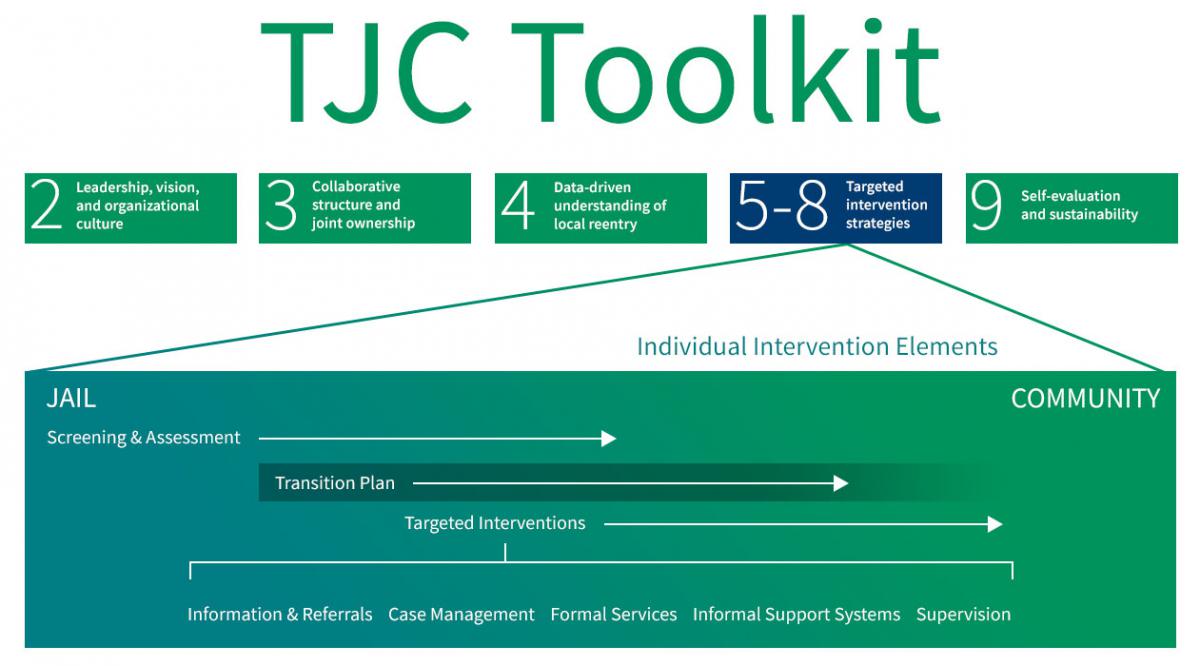
Welcome to Transition Plan Development. This module explores the use of individualized written transition plans that lay out the intervention, treatment, and services for a person in jail and after release, based on prior assessment of his or her risk and needs.
Transition plans are essential in preparing individuals for release and enhancing long-term reintegration, particularly for those who are assessed as moderate or high risk/need. Transition plans also serve as a means by which offenders can open a dialogue with their counselors, case managers, and program or supervision officers to assist in their own treatment and plan for their return to the community.
The most vital piece of successful reentry is a comprehensive reentry plan. This plan should begin as early as possible, and entail having the inmate active in the development and completion of the plan. Community agencies need to build a relationship with the offender and schedule appointments. The plan should be given to community agencies, the offender and facility programs. The comprehensive reentry plan is a road map to success for offenders trying to negotiate the struggles of a new lifestyle.
—Paul Mulloy, Director of Programs, Offender Reentry Center
Davidson County, Tennessee, Sheriff's Office
Before we begin, take some time to think about what transition plans, if any, your jail presently uses. Ask yourself the following three questions:
| 1. | Does your jail facility use transition plans? | |
| 2. | Do your jail facility's transition plans include in-custody, discharge, and post-release components? | |
| 3. | Do risk and needs assessments actively inform the individual's transition plan? |
Did you answer “Yes” to each of the questions? If not, this module is meant to help you develop transition plans that identify the appropriate range of in-jail and community-based interventions for your incarcerated population, given the range of needs identified.
This module has five sections and will take between 15 and 20 minutes to complete.
Recommended audience for this module
- Sheriffs
- Jail administrators
- Correction staff involved in transition efforts
- Jail treatment staff
- Pretrial services staff
- Community corrections staff
- Reentry coordinators
- Community providers
- Probation officers
- Pretrial services
- County board members
- Criminal justice council members
- Judges and officers of the court
Module Objectives
In Module 5: Targeted Intervention Strategies, you learned about the 11 tasks outlined in the Targeted Intervention Strategies section of the TJC Implementation Roadmap and the importance of using the risk-need-responsivity model to determine the appropriate strategies to address an individual's criminogenic factors pre- and post-release.
In this module we guide you through task 4 of the Targeted Intervention section of the Roadmap. This task highlights the importance of developing transition plans for selected individuals during their jail stay based on an objective assessment of risks and needs.
Task 4. Produce transition plans for selected jail entrants.
This module has five sections:
- The Role of Transition Plans
- Transition Plan Content
- Selecting the Targeted Population
- Case Management and the Transition Plan Process
- Terms Used in the Field
By the end of this module, you will be able to
- Explain why transition plans are important.
- Identify the essential elements of a transition plan.
- Determine who receives transition plans.
- Develop transition plans for your population.
Summary
In this section, you learned that a transition plan specifies the types of interventions an individual needs, when and where the interventions should occur, and by whom. A transition plan has three components: (1) an in-custody (prerelease) section, (2) a discharge planning section, and (3) a post-release planning section.
Module 7: Section 1: The Role of Transition Plans
This section describes the important role formal transition plans play in the TJC model. Informed by a valid and objective assessment of risk and needs, a transition plan specifies:
- The types of interventions appropriate for each individual as indicated by a valid and objective risk/needs assessment. When and where interventions should occur and who will provide them
- The activities and appointments for which the individual needs to take responsibility
Transition plans are intended to guide the transition back to the community by developing specific actions and/or strategies designed to address individual needs. . Beyond the obvious advantage of planning for success over the medium to long term, transition plans provide specific direction for an individual during his or her first days post-release, making the transition from jail to the community as healthy and productive as possible. As we are all too aware, choices people make soon after their release are pivotal to their success or failure.
Transition plans target issues such as housing, employment, family reunification, educational needs, substance abuse treatment, and health and mental health services. In many cases, a transition plan is the primary intervention for individuals released within hours or a few days of entering jail.
We use the term “transition” because it embodies a central tenet of the TJC model—that the overwhelming majority of those in jail are passing through—returning to the community—and need help identifying and engaging support and interventions in both locations.
We also recognize that the vast majority of people housed within your jail will transition directly from your jail to your streets in a relatively short period of time making a well-developed transition plan essential for coordination with professionals and supports within your local community to ensure that their services are accessed and have continuity with services already provided while in custody.
A transition plan has three components:
- In-custody (prerelease) plan section
This component specifies prerelease interventions to be delivered either by jail staff or community-based providers conducting jail “in-reach.” - Discharge plan section
This component specifies interventions addressing the “moment of release”—those critical first hours and days after release from jail—and facilitating the provision of needed services in the community. - Post-release plan section
This component specifies interventions for covering the mid- to long-term transition period upon return to the community. Though the post-release plan is initially developed in jail, it is expected to be revised in the community.
Implicit in this approach is the understanding that one size does not fit all and that plans should be tailored to the needs of each individual. Some individuals, for example, will need extensive services and support, including intensive case management, to effectively transition to the community; while others may require only minimal assistance, if any.
Regardless of the individual, however, the goals of a transition plan are to
- Prioritize a person’s higher risk needs identified by a validated assessment.
- Develop an individualized written plan of intervention.
- Identify when goals have been accomplished.
- Identify who is responsible for providing each intervention.
- Link and schedule appointments with community providers.
- Ensure continuity of interventions from jail to the community.
- Establish goals and/or targets of change that are agreed upon by the incarcerated individual and those responsible for his or her custody and treatment.
For more information
1. Burke, P., Herman, P., Stroker, R., & Giguere, R. (2010). TPC case management handbook: An integrated case management approach . National Institute of Corrections.
2 . Burke, P. (2008).TPC reentry handbook: Implementing the NIC Transition from Prison to the Community Model. Information on the “Transition from Prison to the Community Model: Transition Accountability Plans (TAP)” is available on page 212.
3. Carey, M. (2010). Coaching packet: Effective case management .The Center for Effective Public Policy.
5. Christensen, G. (2008). Our system of corrections: Do jails play a role in improving offender outcomes? National Institute of Corrections and Crime and Justice Institute.
6. Conly, C.H. (2005). Helping inmates obtain federal disability benefits: Serious medical and mental illness, incarceration, and federal disability entitlement programs .Abt Associates.
7. Parent, D.G. & Barnett, L. (2002). Transition from prison to community initiative. Abt Associates.
8. Warwick, K., Dodd, H. & Neusteter, S.R. (2012). Case management strategies for successful jail reentry: Transition from Jail to Community Initiative practice brief . Urban Institute.
Module 7: Section 2: Transition Plan Content
This section guides you through the development of a transition plan based on the National Institute of Corrections' Transition Accountability Plan (TAP). According to Peggy Burke, author of the Transition from Prison to Community Reentry Handbook, a transition plan has the following components:
- It is based on validated assessments of risk and needs.
- It indicates appropriate interventions to address the highest areas of criminogenic need.
- It is developed early in the period of incarceration.
- It is shared with members of the case management team.
- It follows the individual through his or her time incarcerated and continues post-release.
- It is automated so that the collaborative case management team can update it and share it across organizational boundaries. 1
At minimum, according to Burke, transition plans should: 2
- Identify the assessed risk level and criminogenic needs of the incarcerated person.
- Develop strategies to address obstacles and triggers.
- Outline the incarcerated person's responsibilities clearly and concisely, and work with him or her to gain consensus on how to carry out these responsibilities.
- Articulate specific goals that are directly related to the highest rated domains of criminogenic need. Each goal should specify strategies that are clearly stated, measurable, attainable, relevant, and have a timeline.
- Afford a degree of flexibility to accommodate change and recognize small successes during planning, treatment, and intervention.
- Identify the individual's strengths or protective factors, and build strategies to maximize prosocial assets already present in the individual's life.
- Assess the need for interventions to minimize the effects of criminal thinking on the realization of goals outlined and agreed upon within the transition plan.
- Assess the individual's readiness for change, and consider the best ways to enhance motivation for change.
The transition plan template (click here) reflects the minimum requirements of an effective transition plan. Our purpose is not to recommend any one transition plan, but instead to provide you with a transition plan template you can modify based on your jurisdiction's needs. However, as discussed in the previous section, each plan must identify the types of interventions to address individual needs, when and where interventions should occur, and by whom.
Discussed here is the rationale for each section of the plan:
- Transition Plan Section
The plan begins with the incarcerated person's name and identifying information. Identifying the individual's current status (pretrial detainee or sentenced individual) and expected release date helps you estimate how much time you have to work with this individual prior to his or her release - Risk Level, Treatment and Criminogenic Needs Section
The plan reminds you of the importance of an objective, validated assessment to guide the transition plan. For example, a person who does not have a substance abuse problem should not be referred to substance or alcohol treatment. You will want to modify this portion of the plan based on the risk/needs assessment used in your facility. Persons who are identified as medium- to high-risk should have more referrals than lower risk people. - Interventions Needed Section
This section of the plan identifies the 10 most common needs incarcerated people face when returning to the community. It’s important to remember that intervention in the following needs is based on assessed needs, not a one-size fits all intervention strategy.- Identification
Recognizing the need for multiple types of identification—for example, to apply for a job, public benefits, or a driver's license—this section determines the number of identification documents a person has. Ideally, the individual will receive a state ID card prior to release or have access to identification application forms in jail to begin the process. - Benefits Eligibility
Recently released persons will need health insurance and a source of income, at least temporarily, until they are employed. Though not all will qualify for public entitlements, this section of the transition plan identifies the available benefits such as Medicaid, SSD, SSI, so individuals can begin applying for eligibility while incarcerated or at release. Many states, for example, now allow individuals to qualify and enroll in Medicaid while incarcerated so they can start using it at the time of release. - Transportation
We know the first few hours and days after release from custody are crucial to successful transition and the availability of reliable transportation upon and after release is an important consideration. Those discharged without reliable transportation home or to a program may find themselves dropped off or walking in an environment that triggers problematic behavior. Over the longer term, transportation is a key factor in gaining and maintaining employment, attending school, making appointments, and participating in treatment. - Housing
Stable housing is an important component of successful reintegration back into the community. Those released without shelter are more likely to return to the criminal justice system. - Medical/Mental Health/Dental
For individual and public health reasons, it is important that recently released individuals attend to their health care needs. A plan to maintain their medical regimen after release, which may include applying to Medicaid or other health insurance coverage, is crucial. Additionally, a referral to a health care provider for any health-related issues is key. Individuals with mental health issues must have medication at release and be ensured of access to continuing mental health treatment beginning immediately upon release. - Substance/Alcohol Abuse Counseling/Treatment
Substance abuse is a dynamic criminogenic risk factor that affects recidivism. Those identified with a recent history of problematic drug use or dependency must be referred to a TJC treatment partner within the community to increase the likelihood of successful transition. - Family
Though reuniting with family members can be exciting, it can also be stressful for both those returning to the community and their families. It is important to know what the family situation is prior to determining whether marital and family counseling and parenting classes are appropriate. Many factors—including family criminality, domestic violence, sexual offense, and varying levels of abuse—are important considerations. - Education
A low level of personal education is a criminogenic risk factor. Though education is often not included in a person's short-term transition plan, it should be addressed as part of longer-term planning, particularly if the person does not have a high school diploma or GED. - Employment
Getting a job is one of the most important things people need to do after release. The job development section helps begin the process by identifying what, if any, skills must be attained before the individual is employable. - Financial Obligations
Paying financial obligations is an important part of the transition process. Failure to pay court fines or child support increases the chance of the person being re-arrested and possibly serving additional time in jail.
- Identification
- In-Jail Program Participation Section
This section identifies the prerelease interventions delivered by either jail staff or community-based providers conducting jail “in-reach” that are available to meet the needs of the incarcerated population. The plan identifies what program(s) a person has participated in and whether he or she will need to continue working on each identified need in the community after release. This section will help determine moving into step-down programs like work release, day reporting, and electronic monitoring. Each jail should modify this section based on its range of existing transition programs and services available within the jail and the community. - Post-Release Community Referrals Section
This section specifies effective, evidence-based interventions within the community designed to continue the work begun in the jail facility to address the person’s needs at the “moment of release”—those critical first hours and days after release—and longer term—weeks and months after returning to the community.
A comprehensive knowledge of community resources by the transition planner is essential. Each individual who needs a referral must be given the agency's name and address as well as a contact person's name, and in many cases the date and time of an appointment. Though the post-release plan is initially developed in jail, it should be reviewed and revised by a community-based partner upon release.
Released individuals often have a difficult time following up on a referral, even when post-release services are available and accessible. This plan includes a reentry accountability plan so the person can work with his or her case manager or counselor to identify behaviors that may impede them from utilizing a referred community service.
- Completion of Plan Section
This section records whether the transition plan was completed and discussed with the incarcerated person. - Case Manager/Counselor Information and Inmate Agreement Section
This section formalizes the transition plan process and requires the incarcerated individual to sign the agreement in an effort to increase buy-in and participation.
Developing a transition plan that is responsive to women
During reentry, women may encounter barriers due to parenting, health, and financial challenges. Women, and especially women of color, may face barriers to employment opportunities due to low levels of educational attainment. Women-specific reentry models with focus on substance abuse and therapeutic communities have proven to be successful.
Jail staff should collaborate with women to develop a tailored reentry plan that ensures access to resources that women will need during their transition from jail to the community. The National Institute of Justice has identified some successful components of community hand-off models, stated below:
- Tailored treatment plans: Treatment plans that concurrently address substance abuse, mental illness, and chronic health conditions . Jail staff, contracted providers, and/or community service stakeholders should work with women to set up an appointment with a mental health provider immediately after release
- Therapeutic communities and peer recovery: Participatory, group-based approaches for women to work through recovery while living together in residential settings. Also connecting with peer recovery specialists who can serve as a form of social support during recovery
- Case management: Case management should be maintained while the individual is under community supervision post release
- Medication assisted treatment: Medication assisted treatment for opioid dependency should be available post release to reduce the risk of recidivism, relapse, or overdose
- Employment: Since women who are incarcerated may have employment and education gaps, there should be a focus on employment programming and connecting women with part-time employment opportunities post release
- Housing: Provision of housing, including housing providers that accommodate children
- Culturally responsive programming: Connect women with local organizations to provide programming to meet the needs of women based on their racial and ethnic experiences
For more information and examples from the field
- Amaning, A. (2024). Supporting women affected by the criminal legal system. In Playbook for the advancement of women in the economy (pp. 257–270).Center for American Progress.
- Burke, P.B. (2008). TPC reentry handbook: Implementing the NIC Transition from Prison to the Community model . National Institute of Corrections.
- Howard County, MD. Detention Center. (n.d.). Howard County reentry checklist.
- Denver Sheriff Department. (n.d.). Denver jail to community reentry case management form.
- Douglas County, KS Sheriff’s Office Corrections Division. (2008). Reentry eligibility, rules and expectations. A comprehensive inmate questionnaire: Reentry eligibility, rules, expectations and development of transition goals.
- Hennepin County, MN. (n.d.). Hennepin County TJC transition plan.
- National Institute of Justice. (2024). Five things to know about women and reentry. U.S. Department of Justice.
- Substance Abuse and Mental Health Services Administration. (2020). After incarceration: A guide to helping women reenter the community (Publication No. PEP20-05-01-001). Office of Intergovernmental and External Affairs.
1 Burke, P.B. (2008). TPC reentry handbook: Implementing the NIC Transition from Prison to the Community model . National Institute of Corrections.
2 Ibid.
Summary
In this section, you learned both the rationale for each section of the transition plan and the 10 most common needs incarcerated people face when returning to the community. A transition plan template was provided, which you can modify to fit your jurisdiction's needs.
Module 7: Section 3: Selecting the Targeted Population
This section provides an overview of whom to target for transition plans. Your goal is to identify higher-risk and -needs individuals who are likely to be released directly to the local community, as the research tells us they stand to benefit the most from an intensive transition plan. Research indicates that lower-risk individuals do not benefit from intensive transition plans and resource limitations often preclude planning for others who are not likely to be released back to the community or for whom someone else will take responsibility for developing a plan (i.e., those facing transfer to state or federal prison).
First, determine if your incarcerated population has been screened and assessed for risk and need and whether that information is easily accessible.
Second, the TJC model recommends using a person's risk and needs levels as the two main criteria to identify who should receive transition plans.
1. Risk
Screen your entire jail population and assign individual levels of risk of reoffending to each incarcerated individual. Set a cut-off point considering the risk screen score and the resources available to provide extensive assessment and transition services to higher risk individuals.
Remember that based on the Risk-Need-Responsivity (RNR) model for assessment and rehabilitation, lower-risk individuals should not be targeted for extensive intervention; however, as indicated in previous modules, they can still receive referrals and information that will address targeted needs. For higher-risk individuals above the established cut-off point, a more extensive risk/needs assessment should be conducted to inform your transition plan. When considering a “cut-off” point, it is also advisable to design your process so that more comprehensive assessments are only performed with people for whom resources or services are available.
2. Needs
Next, identify the criminogenic needs (e.g., antisocial values, substance abuse, family dysfunction, antisocial friends, and low levels of personal education) of the population who have a high-risk score and for whom you will or are able to provide transition planning interventions. As discussed previously in Module 5, research shows a positive relationship between these needs and re-arrest.
Transition plans should also target and address basic survival needs (e.g., identification, housing, employment), health, and mental health needs because homelessness and severe mental illness, for example, can affect transition from jail to the community. Transition plans should address the needs identified by individual risk/needs assessments and avoid a “one-size-fits-all” approach.
Other criteria your jurisdiction will want to consider:
- Length of stay: How long a person is going to be incarcerated is often used to identify where the person receives a transition plan. Generally, you should develop transition plans for sentenced and pretrial persons whose assessments determine the need for a transition plan and who are expected to stay in jail for more than 10 days. Transition plans should be initiated in the community after release for those with high risk and/or needs, but who will be in jail for a shorter period.
- County of release: Will transition plans be provided to people with high risk or needs who are released to counties outside of your jurisdiction?
- Chronic health problems: From a public health standpoint, will all individuals identified with an infectious disease (e.g., HIV/AIDS, tuberculosis, viral hepatitis, sexually transmitted disease) receive a transition plan?
- Capacity: Will time and monetary cost, staff availability, and staff training limit transition plans, even for those who meet the threshold criteria? Is some method available to target the highest need individuals to ensure the best expenditure of available resources?
- Receptivity: Will the transition plan be voluntary? The TJC model recommends that all persons who meet the criteria receive a transition plan, regardless of their initial receptivity to the process.
- Incentives: Develop incentives to foster participation and engagement in the recommended services and treatment while in custody and especially post-release.
- In-jail Incentives
- More visitations
- Later curfews
- More phone access
- More recreation time
- Additional meals/snacks
- More television
- Movie nights
- Access to more television channels
- Certificates of completion
- Letters of recognition
- Improved housing assignments
- Extra or early movement into community corrections
- Good-time credits
- Community-based Incentives
- Bus passes
- Access to phone cards
- Food
- Special activities for people who participate in programs – donated from community
- Better housing
- Family reconciliation
- Certificates of completion
- Letters of recognition
- Being asked to serve as a mentor to other formerly incarcerated individuals
- Reduction of conditions
- Early termination of supervision
- In-jail Incentives
For more information and examples from the field
1. La Crosse, WI. (n.d.). Proposed La Crosse TJC process. A case flow chart outlining screening assessment, targeted treatment and transition planning.
2. Lowenkamp, C. T., & Latessa, E. J. (2005). Developing successful reentry programs: Lessons learned from the ‘what works’ research . Corrections Today, 67(2), 72–77. Lowenkamp, Christopher T. and Edward J. Latessa. 2005.
3. Howard County, MD. (n.d.) Howard County jail transition reentry map.
Summary
In this section, you learned that an individual's risk and needs level should be the main criteria for identifying who should receive a transitional plan.
Module 7: Section 4.1: Case Management and the Transition Plan Process
In this section, we discuss case management and the transition plan process. Ideally, one individual oversees and coordinates all phases of the transition plan. This individual could be a correctional case manager, community service provider, community supervision officer (pretrial and/or probation), correctional program staff, or other designated staff member.
For the section that follows, we use the term “case manager,” but this role could be filled by someone inside or outside the jail—or both, with a dual-based case management system.
Keys to Effective Case Management
- Make a connection at the first meeting.
- Have a good orientation for each client.
- Provide a welcoming environment.
- Establish an empathic relationship with the client.
- Complete a comprehensive assessment of the client.
- Engage clients and link them to appropriate interventions.
- Develop a comprehensive treatment plan to which clients agree and commit to being held accountable.
- Develop a written contract that focuses on short-term goals and accountability.
- Work with the client to develop a comprehensive aftercare plan.
- Provide a system of incentives to assist clients in meeting their goals.
- Have a good understanding of the communities to which people return.
- Be aware of community services and resources.
- Understand that different treatment approaches suit different clients.
- Provide regular opportunities to review progress with the client.
Only service providers committed and accessible to the incarcerated population should be included in a transition plan. It is frustrating when the formerly incarcerated contact service providers only to discover that the location is overloaded or cannot provide a service for some other reason. It is also imperative that the services provided do not conflict with or contradict services that people have received while they were in custody. Each of these factors create unnecessary conflict and obstacles early in a person's transition; therefore, we recommend that the transition planner contact providers to verify their interest and ability to work with the returning population and that their services have continuity with all that was accomplished in custody. Ideally, the services will be available for free or on a sliding scale.
You may also want to have a conversation with service providers about the use of appointments. Many people have a difficult time making their appointments after they are released and tend to show up at services hours, if not days, late. Discuss with service providers how they can service the drop-in population, understanding the need to provide services to formerly incarcerated individuals regardless of their limitations, especially soon after their release from jail.
Unity Health Care, Inc., the largest provider of medical care in Washington, D.C. to the medically underserved and the homeless population, has an open-access system. Individuals get an appointment the day they call. Unity allows an override for patients coming from the D.C. jail because they want as much access for this population as possible.
In addition to the “hard” components of the transition plan identified above (risk/needs), what is most important is the professional's ability to work with the incarcerated person to design a transition plan that facilitates behavioral change while in custody and continues after release. Therefore, although the case manager starts the transition planning process, to achieve maximum effectiveness, the transition plan must be developed in collaboration with the incarcerated person.
Corrections professionals know that the individual's participation in the transition planning process increases adherence to the plan and that people with higher risk and needs can often recognize their problems and have preferences about which interventions are best suited for them. Simply stated, a person who views his or her transition plan as his or her own will be more likely to adhere to agreed-upon actions and will be far more likely to avoid behaviors associated with recidivism.
The transition plan process has six steps:
Step 1: Identify the transition plan population.
Step 2: Begin to fill out the transition plan.
Step 3: Prepare the transition plan in consultation with the incarcerated person.
Step 4: Identify interventions.
Step 5: Make referrals.
Step 6: Ensure that the transition plan follows the person back to the community.
Case Management and Planning that Is Responsive to Women
Case planning for women should prepare for specific barriers and needs that women may face during the reentry process. Consider adopting guidance from the Collaborative Case Work Model for Justice-Involved Women (CCW-W) (previously known as the Women Offender Case Management Model (WOCMM), designed specifically for use with women in the criminal legal system. CCW-W is based on nine core principles stated below:
1. Provide comprehensive case management that addresses the complex and multiple needs of women in the criminal justice system.
2. Recognize that all women have strengths that can be mobilized.
3. Ensure that women are collaboratively involved to establish desired outcomes.
4. Promote services that are unlimited in duration.
5. Match services in accordance with risk level and need.
6. Build links with the community.
7. Establish a multidisciplinary “case management team.”
8. Monitor progress and evaluate outcomes.
9. Implement procedures to ensure program integrity
CCW-W consists of four distinct, overlapping activities to be incorporated into case planning, stated below:
- Engage and Assess: Provide a comprehensive, women-responsive assessment. The assessment can help build rapport with the woman and draw awareness to her strengths (which can buffer or mitigate risk) and needs (which can contribute to future criminal justice involvement).
- Enhance Motivation: The case management should develop intrinsic motivation and empower women in seeking change. Consider women-centered approaches including Relational Theory and Motivational Interviewing (MI).
- Implement the Case Plan: The case planning team must be prepared to deliver relevant services when the woman is ready for case planning. Women should be presented with a variety of service options and opportunities in four primary areas: vocational, personal, social and life needs. By building personal strategies and growing social capital, the team can help move the woman toward self-sufficiency.
- Monitor Progress: This stage ensures that the Case Plan is constantly monitored and updated. The case plan is a tool for women that helps (1) review progress and reinforce successes (2) to review barriers to success and introduce problem-solving strategies and, (3) to develop new goals and action steps as needed.
Practitioners should also consider other unique needs of women during reentry. For example, data show that women in prison are between 18 and 44 with a median age of 34. Based on available statistics, it is likely that women in jail are young, falling into the age range to experience menstruation and/or pregnancy with a need for access to reproductive healthcare. Other considerations include setting women up with housing options that accept children. Additionally, women can benefit from part-time employment opportunities that allow flexibility for childcare responsibilities.
For more information and examples from the field
1. Burke, P., Herman, P., Stroker, R., & Giguere, R. (2010). TPC case management handbook: An integrated case management approach. National Institute of Corrections.
- Clarke, J. G., & Simon, R. E. (2013). Shackling and separation: Motherhood in prison. American Medical Association Journal of Ethics, 15 (9), 779–785
- Fresno County, CA. (n.d.). Fresno County TJC participation agreement.
- Healey, K. M. (1999). Case management in the criminal justice system. (Research in Action). National Institute of Justice.
- Orange County, CA. (2009). Orange County transitional reentry center. Transitional reentry center compliance agreement and instructions – contract style form signed by participant and probation officer.
- Millson, B., Robinson, D., & Van Dieten, M. (2010). The women offender case management model: The Connecticut project . National Institute of Corrections.
- Taxman, F. (2006). Assessment with a flair (purpose): Offender accountability in supervision plans. Federal Probation, 70 (2), 2–7.
- Warwick, K., Dodd, H., & Neusteter, S. R. (2012). Case management strategies for successful jail reentry. Urban Institute.
Consent Form Examples
- Denver Sheriff Department. (n.d.). Release of Information. Inmate's consent form for release of reentry information
- Douglas County, KS Sheriff's Office. (2009). Reentry Release of Information. Inmate's consent form for release of reentry information
- La Crosse County, WI. (n.d.). Reciprocal authorization for disclosure of confidential information. Inmate's consent form for release of reentry information
Summary
In this section, you learned that the transition plan is a six-stage process. Key to the process is involving the incarcerated person in the transition planning.
Module 7: Section 4.2: Steps
Step 1: Identify the transition plan population
- Review all screens and assessments gathered at intake.
- Identify assessed individuals in need of a transition plan, and determine who will receive more intensive interventions based upon a risk triage process.
- Generate a list of soon-to-be-released individuals to further assist triaging based on risk, needs, and length of stay.
Step 2: Begin to fill out the transition plan
- Fill out sections of the transition plan using information available from the person's file, inclusive of information obtained while under pretrial supervision.
- Triage activities dictate who should be seen first and to what extent he or she will receive service and/or further assessment.
Step 3: Prepare the transition plan in consultation with the incarcerated person.
- A program room, booking area, or other space in the jail should be designated for transition planning conferences.
- To maximize effectiveness and impact, case managers, counselors, or officers responsible for transition planning meet face-to-face with incarcerated individuals to discuss and form transition plans, including the interventions needed both in jail and after release to the community.
- If prerelease interventions are required, offer to help the transitioning person apply or sign up.
- Discuss pre- and post-release interventions and make referrals as indicated by interviews and assessments. Incarcerated individuals receive a copy of the transition plan with names of the service providers, addresses, telephone numbers, time and date of appointments, and, if possible, public transportation routes to get there.
Step 4: Identify interventions
The case manager, reentry director, counselor, or officer
- Counsels the incarcerated person on interventions available in the jail and in the community.
- When feasible, invite a community service provider into the jail to meet face-to-face with the person prior to his or her release to enhance successful linkage and responsivity after release.
- Works with jail classification and security to coordinate transition plan activities, including housing assignments, program attendance, and referrals to in-custody and community-based services.
- Develops incentives (e.g., increased visitation, release earlier in the day for those with a plan, improved access to services) to reward the person for starting the in-jail component of the plan and meeting short-term goals.
- At a minimum, create a mechanism and timeline to update a transition plan when the incarcerated person completes in-jail programming. The transition plan should act as a “living” document and be reviewed with the incarcerated individual and updated to reflect progress and new goals.
Step 5: Make referrals
The case manager, reentry director, counselor, or officer
- Communicates with evidence-based community programs and agencies to ensure intervention referrals.
- Revises transition plans as changes occur.
- As much as practical, acts as a liaison with community entities to support and invite their presence within the jail. May make presentations and provide information as well as meet potential referrals prior to their release.
- Schedules referrals for appointments for specific times whenever possible.
- Notifies local health departments in advance of the release of any person with an infectious disease such as active tuberculosis.
Step 6: Ensure that the transition plan follows the person back to the community
The case manager, reentry director, program staff counselor, or officer
- Determines a comprehensive process for having transition plans follow people from jail to the community.
- Ensures that transition plans are written in a format that allows them to also be used by probation officers and service providers upon release.
- Ensures that all individuals with mental health issues leave with medication and an appointment at their local health clinic.
- Contacts all individuals with high risk and/or high needs within the first week after release to determine if they have kept appointments, maintained prosocial contacts, complied with treatment or probation directives, and maintained employment. Provides any additional help or referral that might be necessary.
Module 7: Section 5: Terms Used in the Field
This section defines basic terms used in this module.
Case manager:
The individual responsible for establishing transition planning and addressing issues and/or needs during and after incarceration.
Criminogenic:
Recognized factors that are proven to correlate highly with future criminal behavior.
Discharge plan section:
Specifies interventions addressing the moment of release—those critical first hours and days after release from jail—and facilitating the provision of needed services in the community.
In-custody (pre-release) plan section:
Specifies prerelease interventions to be delivered by either jail staff or community-based providers conducting jail “in-reach.”
Post-release plan section:
Specifies interventions covering the mid- to long-term transition period to the community. Although the post-release plan is initially developed in jail, it should be revised in the community.
Prosocial:
Caring about the rights and welfare of others. 1
Transition plan:
Preparation and strategy for individual releases from custody, preparing them for return, integration, and treatment (as indicated by criminogenic need) within the community. In some jurisdictions, transition plans are referred to as case management, discharge, reentry, supervision, or aftercare plans.
Trigger:
“A stimulus which has been repeatedly associated with the preparation for, anticipation of, or the use of alcohol or other drugs. These stimuli include people, places, things, time of day, emotional states, and secondary drug use.” 2
1Santrock, J. W. (2007). A topical approach to lifespan development (4th ed.). McGraw-Hill.
2 Zweben, J. E., Hora, P. F., & Cohen, J. B. (2004). Moving evidence-based treatment into the drug court setting . Center for Substance Abuse Treatment.
Summary
In this section, you learned basic terms that are used throughout this module.
Conclusion
The main goal of Targeted Intervention Strategies is to develop and implement individualized transition plans based on assessed risk and needs in order to coordinate evidence-based programming and services in the jail, and to link incarcerated individuals with appropriate community resources upon release. Well-conceived transition plans group incarcerated persons by risk and need, consider all post-release treatment/placement options, offer services in jail that are consistent with those in the community, and place high importance on the input and assistance of the incarcerated persons themselves. Such plans position both incarcerated persons and system professionals to achieve the many benefits associated with successful transition from jail to the community.